Aesthesys: The Book of Tea

Read with AI
ChatGPT and Claude open with a ready-made prompt — you send it yourself. Perplexity launches the query right away. Gemini has no prefill: we copy the prompt and open the app so you can paste it yourself.
Prompt copied — paste it into Gemini
Contents
Before the First Cup

A cup has a weight you do not notice right away. While it sits on the table, that weight belongs to the table. Your hand touches the warm surface, your fingers settle around its side, and for a brief instant the object rests between two supports. Then the table releases it. If you move slowly enough, you can feel that the cup is received by more than just the hand: the position of the shoulder shifts slightly, the back responds, the seat beneath the pelvis is felt more clearly. A small weight enters a larger one.
The tea has not yet been drunk. Almost nothing has happened. It is precisely this "almost" that holds our interest.
We are used to judging what matters by the scale of its consequences. A meeting ought to change a life, a book should offer new ideas, a journey should broaden our horizons. From a cup of tea we expect at least a lift in energy. We have any number of well-mannered ways to explain why we do what we do, and at times these explanations are so convincing that behind them it becomes hard to hear the act itself.
Meanwhile, water meets tea without any concept of ours. The tea unfurls at its own pace. The liquor darkens. The cup cools faster than the teapot. A dryish sensation appears on the tongue after the taste has already begun to fade, and the empty vessel holds an aroma that was not there when it was full. All of this can be missed without making any mistake—the drink will be drunk all the same.
You can also linger.
This book grew out of a desire to understand what opens up to a person in such lingering. What interests me is the tea ceremony as an art: a living act in which teaware, movements, taste, pauses, and people form a temporary work. You cannot carry a finished object away from it. Sometimes the memory of a particular tea remains, sometimes a more precise sense of how you exist right now. Sometimes nothing definite remains at all, and that in no way makes the gathering a failure.
The word "ceremony" itself promises more solemnity than I would wish. It immediately conjures up a special costume, a canonical sequence of gestures, and a leader who knows something inaccessible to everyone else. Yet a ceremony can be simple. In it you can smile, shift your posture, discover that the tea has come out too strong. It needs form, yet the form does not have to be heavy. Good performance, in fact, often frees us from the need to think about the performer.
Tea offers remarkably varied material for this. It can be studied as an agricultural product, bought as a rare commodity, compared as gastronomy, or passed down as a family custom. Around it one can easily arrange a competition, a conversation, a lesson, or an hour of silence. All these ways exist side by side, and none of them holds the exclusive right to explain the others.
That is why we will begin with history. History helps us see that the tea forms familiar to us today were once new, that Chinese tea culture was never reducible to a single ritual, and that behind the clear liquor stand land and labor, trade routes and political power, craft invention and ordinary human thirst. History does not take away the pleasure—it simply makes it less forgetful.
Then we will draw closer to the tea table. What turns the preparation of a beverage into an art? How can we be together without producing anything useful? Why does cultivating taste concern more than the tongue and palate? And what is left to the human being in a world where more and more intellectual operations can be delegated to a machine? It is easy to make these questions too large, but the cup in the hand will keep them within reach.
In the third part, the practice itself appears. We will prepare the space, choose the tea and teaware, learn our way around water, and move through the seven focuses of attention in AESTHESYS TEA Practice: sense of time, weight and volume, touch, taste, aroma, sight, and hearing. I call them the working composition of the practice rather than a list of physiological sense organs: balance, temperature, body position, and the sense of time belong to different systems of the organism and do not fit without remainder into an elegant number. What matters for practice is something else—how they become accessible together, and what a person can do with the differences thus discovered. If you would like to try the practice first, you can turn to Appendix I for the full score of a group gathering. For getting acquainted on your own, Appendix II offers a brief map of the seven focuses.
The fourth part of the book is devoted to how sensitivity develops—and what illusions can grow alongside it. A good vocabulary helps distinguish nuances of aroma, yet it can also prompt what we have not yet actually felt. An experienced person notices more, yet their confidence is trained as well. Refined taste issues no certificate of morality: a master may be an attentive host, or may use their knowledge as a means of domination. To leave these questions outside the book would be to make its life too easy.
This work has a philosophical name—AESTHESYS [A1]. It goes back to the Greek aisthesis: sensory perception and the capacity for discernment. Yet tea here will not serve as an illustration of a system prepared in advance. It has the right to resist it. A cup that is too hot is more convincing than a discourse on relaxation, and a tea liquor that did not turn out is more substantial than a fine story about an old tree.
I am drawn to the thought of the body as the visible and tangible layer of our existence. The word "layer" is key here: it leaves room for language, memory, imagination, relationships, and knowledge. Attention to the body does not narrow the world to the boundary of the skin—on the contrary, it is through the body that we discover the room, the other person, the distance between us, and our own participation in what is taking place.
In this book you will encounter personal intuitions, philosophical conjectures, historical accounts, and the findings of scientific research. They should not pretend to be one another. References to studies have been placed in the notes so as not to interrupt the reading. The reader always retains the right to verify a claim and not to share an interpretation.
There is another right as well: simply to drink tea.
There is no need to turn every cup into an exercise or to improve yourself at every touch of porcelain. At some point the practice should become familiar enough not to require constant talk about practice. Then you discover that the tea has already unfurled, the water has cooled a little, and the person across from you wants to say something.
Let us begin with what came before our explanations: with a plant that grew in its own forest until someone decided to put its leaves into hot water.
Part IThe Culture of Tea

1. A Leaf Older Than Legend

Origin stories love chance. Water boils, a leaf glides down from a branch, a ruler takes a sip—and humanity acquires tea. The plot fits into a few sentences; it has a hero, a moment of discovery, and the almost imperceptible co-authorship of nature. Such a tale is easy to repeat: it compresses a long process, distributed among countless nameless people, into a single picturesque scene.
In the Chinese tradition, this scene is linked to the name of Shennong, the Divine Farmer and knower of plants, who tested herbs and poisons on himself. The legend makes tea a reward for attentiveness to nature, and its cultural meaning does not depend on whether a calendar date can be placed beside it. Yet for the history of the use of tea, it does not serve as an eyewitness account. Legend answers the question of how people wish to see the beginning of their culture; historical inquiry asks what traces have survived and what they allow us to claim.
The Camellia sinensis bush is immeasurably older than human stories about it. Before becoming a clear liquor in porcelain, tea may have been chewed raw, boiled in broths with other food, or used as medicine. Even the character 荼 (tu), which a later reader confidently translates as “tea,” in early texts often designated a broad group of bitter plants; the familiar character 茶 became fixed only by the Tang dynasty. The antiquity of a name and the antiquity of the drink we know are two different things.
At times material traces lead further back than written genealogies. In 2016, a team of researchers led by Houyuan Lu compared microscopic plant structures and chemical markers from a compressed plant mass from the Han burial complex of Yangling near Xi'an and identified them as tea buds roughly two thousand one hundred years old. Similar finds from western Tibet showed that tea traveled along caravan routes across the plateau long before the dates familiar from textbooks [1]—the appearance of tea in Tibet is usually dated to the seventh century. And in 2021, residues of brewed tea were found in a bowl from a Warring States period tomb in Zoucheng (Shandong province): they are about 2,400 years old, three centuries older than the Yangling find [2].
What matters here, however, is the mode of inference itself. We see organic residue, the dating of a stratum, and a chemical profile. We do not see the ancient person holding a cup. A burial find does not tell us how that drink tasted, what was spoken of around the cauldron, or whether the act was considered an art. Imagination hastens to reconstruct from a single find an entire interior filled with quiet evening conversations, yet it is better to leave a little air in the past. What remains unknown is a legitimate part of the historical picture.
Gradually, from the southern and southwestern foothills, tea entered the life of monasteries, court chambers, trading posts, and city shops. The popular story that tea was “invented by monks specifically for meditation” oversimplifies this complex coexistence. Monasteries did indeed make an immense contribution to tea culture, yet the plant never belonged to religion alone [3]. An invigorating drink was needed by a monk keeping night vigil, an official bent over papers, a traveler on the road, and friends in long conversation.
This coexistence has a direct philosophical consequence. Today, tea is sometimes asked for credentials of a special spiritual origin—as if ordinary thirst or pleasure in taste somehow demeaned the drink. Yet culture does not grow deeper when everyday life is crossed out of it. Attention to a cup can grow out of hospitality, curiosity, an interest in craft, or habit, and all these acts have no need of a single obligatory meaning.
In the second half of the eighth century, tea found its famous systematizer: Lu Yu. His “Cha Jing” (“The Classic of Tea”) is not the record of a single ceremony, but a compendium of knowledge on botany and soil, the plucking and pressing of tea, twenty-four implements, the choice of water, the building of the fire, the stages of boiling, and the geography of the finest harvests [3, 4]. The very structure of this book is striking. The man posterity would call the Tea Sage examines the shape of tongs, the quality of charcoal, and the properties of river water with equal care. What a modern reader tends to divide into the spiritual and the technical, for Lu Yu, lives within a single field of attention: a lofty attitude toward tea will not help if the water is spoiled or the fire smokes.
At the same time, Lu Yu was no silent guardian of universal consensus. His text contains preferences, disputes, and sharp judgments: he rejects crude methods of preparation, dismisses clumsy teaware and superfluous additions that drown out the taste of tea. A decoction with scallions, ginger, orange peel, and mint he calls water from a gutter—while he himself advises adding a pinch of salt to the cauldron at the first boil [4]. “The Classic” testifies not that ancient people always drank tea properly, but that already in the Tang dynasty a lively polemic surrounded the cup. Tradition contained disagreements long before it came to seem a single monolith.
This frees us from tiresome reverence. The very same tea passes through soil, the plucker’s hands, the fire of the cauldron, the water, and the walls of the vessel—quality is born across the entire chain. When a ceremony is described exclusively as the expression of the host’s inner state, that chain disappears. Only a single author remains on stage, even though in every cup the invisible labor of dozens of co-authors is present: those who tended the bushes, plucked the tea under the sun, tossed it on bamboo sieves, sorted it, and transported it. Good execution at the table, by its lightness, makes the labor almost imperceptible, yet does not compel us to consider it inconsequential.

On commercial packaging, this multiplicity is often replaced by a single geographical name—the name of a mountain, an island, or a remote village. On the label, mist drifts above an old tree, and it seems as though the landscape brewed itself and sent itself to us in a parcel. Yet a locality becomes taste only through concrete work: on what day the tea was plucked, how long it was withered, whether the heat in the cauldron was held steady, under what conditions it was stored. The picturesque quality of an image does not equal transparency of origin.
Even the familiar opposition between “living handwork” and the “soulless machine” calls for qualification. A manual action may be a master’s subtle response to the particularities of a given harvest, or it may simply take more time without any gain in taste. Slowness in itself guarantees neither the quality of the tea nor fair working conditions. A philosophy of presence must sustain this distinction; otherwise it begins to judge the world by the pleasantness of its own imagination.
Production has its own long time, which does not coincide with our desire to drink. The bush grew long before the evening we have chosen, and the tea maker made decisions that can no longer be undone by even the finest water. Brewing offers one last opportunity to meet the material with care, though not an all-powerful one. That is precisely why respect for tea includes the right to acknowledge failure. It happens that even a rare or aged sample, after several attempts in different teaware and with different water, remains flat, musty, or simply alien. To admit this is not to show disrespect toward tradition. Perhaps the issue lies in storage, perhaps in our water, or perhaps this tea is simply not for us. Such a plain observation restores honesty to the particular encounter.
The agricultural nature of tea keeps aesthetics close to the earth. Beauty here depends on weather, soil, the living leaf, and human hands, not only on the meaning we are ready to lend it. Raw material, processing, and brewing make the encounter possible, and the encounter itself takes place in the moment of a sip. In this transition from what is produced to what is experienced, tea becomes culture.
Tea does not need a legend to deserve our attention. Yet human beings need stories to bind a single sip to a longer world. A good story preserves that bond, allowing us at once to love the legend of the leaf falling into the cauldron—and to remember clearly that what is before us is a legend.
2. Cauldron, Foam, Unfurled Leaf

An antique bowl in a museum is easier to understand once we stop treating it as a rough draft of a modern cup. It might be wide and heavy, dark inside, awkward for the small sip we are used to. Yet it was thrown on the wheel for a different action: the object had its own work to do.
In the history of tea, what changed was not merely fashion in ceramics — the very verb by which the drink was made changed, and with it the focus of human attention. Tea was boiled, whisked, and steeped. The first method asks you to watch a cauldron coming to the boil; the second turns a dense cap of pale foam into an event; the third opens to the eye the slow unfolding of the whole leaf. Each verb sets its own stage.
In the Tang culture described by Lu Yu, compressed tea held sway: a dense brick was toasted by the fire, ground fine, and cast into a boiling cauldron [4]. Without digital thermometers, the stage of the water was read by its bubbles and its sound: Lu Yu describes “fish eyes,” “strings of pearls” along the walls, and “surging waves.” The image of “wind in the pines” for water coming to the boil would appear later, in Song poetry (in Su Shi). Still, there is no need to romanticize the absence of instruments for its own sake: having to watch the cauldron made one person a master and left another with mere approximate habit. And today a kettle with precise degree control does nothing to cancel living perception: the device helps reproduce a temperature, but linking that temperature to its response in taste still falls to the person.
In the Song era, the whisking of powdered tea came into its own. Finely ground in stone mills, the tea had hot water poured over it directly in the bowl and was whipped with a bamboo whisk into a dense, lasting foam [3, 5]. The very optics of the tea session shifted: whereas today we look through clear tea liquor down to a white porcelain bottom, the Song connoisseur admired the contrast of white foam against the dark, deep glaze of a jianzhan bowl patterned with “hare’s fur” or “oil spot.” Taste lived side by side with spectacle, and the bowl was a full participant in the comparison — whose foam would stay alive longest without baring a trace of water at the rim.
To picture these forms as a straight ladder of progress makes no sense — otherwise one would have to explain why later generations gave up the intricate Song art in favor of simple steeping. Yet the scheme of a “golden age followed by decline” is no better. It is more accurate to see a shift in artistic possibilities.
When at the beginning of the Ming dynasty the Hongwu Emperor, by an edict of 1391, replaced the tribute of labor-intensive compressed teas with loose-leaf tea, steeping gradually took hold in the culture [6, 7]. Naturally, an administrative decree and household habits move at different speeds, yet the overall vector opened an entirely new field of attention. The craft of millstones and whisk receded — and in its place came the possibility of distinguishing successive infusions, playing with the seconds of contact between water and tea, watching a tight bud unfurl into a living shoot, and developing distinct technological paths: from the heat fixation of green tea to the complex oxidation and roasting of oolongs.
That is why the question “what kind of tea did people drink in antiquity?” always calls for a counter-question: when, in which province, at court or in an ordinary home? A connoisseur’s text is not population statistics, and a graceful vessel surviving in a museum case does not prove that silence and mutual harmony always reigned around it.
Real objects, however, have an advantage over general speculation: they offer material resistance to overly smooth schemes. The angle of a spout directs the stream in a very definite way; the thickness of a wall alters heat transfer and the feel in the palm; a flared or gathered rim delivers liquid to the lips differently. You do not need a historical reenactment to feel this. Pour ordinary drinking water into a small thin cup and into a heavy thick-walled mug: the water is the same, yet the movement of the wrist, the tilt of the head, and the anticipation of the sip will be different. The history of an object begins right here — in the way a form invites us to act. Usually we notice an object’s invitation only through awkwardness: a lid slips, a handle burns, a cup is too narrow [8]. A well-made instrument, by contrast, seems to dissolve into the action — yet that disappearance is paid for by the potter’s exact thought. In a tea gathering, the master ceramist continues to act through the clay and the balance of the vessel long after he himself is no longer there.
Historical perspective helps separate the physics of the material from the style of an era. We do not need to light charcoal in a city apartment out of fidelity to Tang fire, and a table and chair take nothing away from the depth of a tea session. The AESTHESYS practice draws on Chinese and Taiwanese tea and the instruments created around it, yet it makes no claim to restore some “single original ceremony.” It lives in the present day, with today’s bodies and today’s questions. And still, an old bowl can alter a modern movement of the hand — simply by reminding us how attentively human beings once related to what we have grown used to doing mechanically. Cauldron, foam, and unfurled leaf leave us as their legacy the capacity to seek anew a form proportioned to the tea and to the people at the table.
3. The Long History of a Small Teapot

A small Yixing teapot can look more convincing than a thick book. It fits on the palm, its matte darkened surface holds the traces of time, its base bears a carved maker’s seal that most guests cannot read, and beside it stand cups too small for ordinary thirst-quenching. The objects promise a special inner order, and you cannot help wanting to learn the rules.
At that moment the word gongfu (工夫 / 功夫) is usually spoken. It means mastery built up through time, labor, and thoroughness. In the context of tea, gongfu cha refers to a family of preparation methods in which a generous proportion of dry tea is placed into a relatively small vessel and brewed in short successive infusions. (At the same time, the word gongfu in the name of red teas — gongfu hongcha — historically referred to the painstaking crafting of the tea itself, not to the way it is served [9]. A coincidence of sound does not guarantee a coincidence of subject.)
The genealogy of the modern tea ceremony grows especially interesting once we let go of an imagined straight line reaching back into deep antiquity. Such narratives are called “invented traditions” [10]. Lawrence Zhang traces how the regional practice of Chaozhou (the Chaoshan cultural region in eastern Guangdong) and southern Fujian underwent a thorough aesthetic reworking in Taiwan during the second half of the twentieth century, and then spread to mainland China as a nationwide “tea art” (chayi, 茶藝) [11]. Moreover, Japanese influences — above all the steeped-leaf tea culture of senchadō — also took part in shaping this modern canon, though they were later left in the shadow of the national narrative.
This does not mean at all that gongfu cha was invented yesterday for tourists. It simply means that a regional everyday skill and a modern staged presentation have overlapping but non-identical biographies. When a habit moves from a domestic setting into a classroom or a tea club, its structure changes: what people at home in Chaoshan did wordlessly between conversations now has to be broken down into elements, taught, and supplied with explanations.
The anthropologist Peter d’Abbs, who studied the contemporary life of gongfu cha in Chaoshan itself, draws a precise distinction between three contexts: everyday tea drinking at home and among friends, the attentive practice of connoisseurs, and the commercial leisure of teahouses [12]. In the everyday circle he describes, people gathered around a small teapot talk, laugh, discuss business, and greet neighbors — it never occurs to the participants to call what is happening “art.” And yet the continuous rhythm of pouring, the waiting for one’s cup, the attention to a guest, and the familiar sequence quietly hold the social fabric of the gathering together.
For a Western seeker of spirituality, a useful question arises here. If people at the table are talking and smiling, does that mean they have lost depth? Or have we brought with us too narrow a picture of what depth is supposed to look like? A tea table can sustain a living connection without a single discussion of mindfulness. Then again, everyday habit by itself guarantees nothing either: it can be warm, or it can turn mechanical; in just the same way, a professional staging may prove an empty backdrop, or it may open access to a silence and discernment that domestic custom never offered. The boundary runs inside each form, not along the line of “authentic at home, artificial on stage.”
Alongside gongfu cha, one often hears the phrase pincha (品茶). The literal semantic field of the character 品 is bound up with tasting, discerning, and appreciating the qualities of tea [9]. In different circles the term is used for formal tasting, comparative study of samples, or simply an attentive tea session. If we understand pincha as the direction of attention toward the qualities of the tea and the liquor, and gongfu cha as the culture of skillful handling of small teaware and short infusions, the false competition between them disappears.
Imagine three people at the same tea table. The first works with tea professionally and wants to gauge the cleanness of the roast and the storage potential of a batch. The second is holding a small cup for the first time in their life. The third has dropped by after a long week simply to sit with friends. The very same oolong liquor will become three different events for them — yet their expectations will meet within a shared sequence of actions. The professional will catch the work of the fire in the third infusion, the newcomer will marvel at how long the emptied porcelain cup holds its fragrance, and the tired friend will simply warm their hands and exhale in the pause between pours. A well-arranged form does not demand the same report from all three: it gives each person their own entry into shared time.
The flexible history of the small teapot trains us to choose our form responsibly. In a European tea room today, a Taiwanese teapot, a Guangdong cup, an electric kettle, and a chair made by a local joiner may well keep company. That combination needs no justification by purity of origin — what it needs is coherence of movement. And then the best tribute to tradition becomes a clear understanding of the work itself: why the liquor is decanted from the pot to the last drop so the tea does not stew in residual water; why neighboring infusions are compared; how the shape of a cup’s rim changes the delivery of the liquor. The small teapot ceases to be a pass into a closed world and turns out to be what it actually is: an exact instrument of human skill, honed over generations.
4. Tea Crosses the Sea
On the European table, tea long looked foreign. Foreign were the plant itself, its name, the thin-walled teaware, and the habits of handling boiling water. And then all of it became so domestic that it felt as if a cup of tea had always been waiting for a person right here—in a familiar armchair, beside a sugar bowl, milk, or a slice of lemon.
Between the foreign and the domestic lies an immense trade.

Tea spread along several sea and overland routes at once—on Portuguese and Dutch ships, through British trading companies, along Siberian caravan tracks via Kyakhta into Russia—while court fashion made it desirable. You cannot tell this story simply by expanding a Chinese tea room to the size of the globe. On new shores, tea entered different systems of relations—with local utensils, climate, the routines of factory and office labor, diet, and social hierarchy.
This connection comes through with particular clarity in British history. The transformation of a rare imported product into an everyday drink of factory districts and urban outskirts went hand in hand with the Atlantic sugar economy, which rested on the slave labor of colonial plantations [13, 14]. An ordinary sugar bowl on a home table gives this history an almost uncomfortable concreteness: before us is not an abstract “age of empires,” but a substance a person puts into their cup. Of course, it does not follow that every sip must be accompanied by a rite of public repentance—what we need is clear memory capable of changing understanding and action, not a display of our own moral purity.
Just as closely, British demand for tea became intertwined with a silver deficit and the trade in opium from British India, which led to the Opium Wars [15]. We tend to arrange history in separate display cases: in one, refined taste, collectible porcelain, and an interest in the East; in the other, tariffs, gunboats, and coercion. Yet tea chests and silver were carried by the very same ships. Separating aesthetics from economics is convenient for a museum, but too sterile for understanding.
Even the history of how tea plantations developed in India requires precision. The colonial account of how a nineteenth-century British explorer “discovered” wild-growing tea in Assam passes over a simple fact in silence: local inhabitants, in particular the Singpho people, had known and used this plant long before specimens reached the botanical archives at Kew [16, 17]. The word “discovery” in such chronicles often marks the moment when someone else’s knowledge finally entered the catalog of the stronger side.
What followed was the industrial plantation—a large-scale organization of land, labor, logistics, and capital aimed at producing large, repeatable batches. The buyer gained predictability of taste, and for a person who needs a familiar hot mug before the workday begins, that stability became a real virtue. The only question is how much human labor and history remains hidden behind familiar convenience.
Eastern European tea drinking around a samovar, British tea with milk, strong tea liquor in a Turkish tulip-shaped ince belli glass, and Chinese infusions in a small gaiwan all serve different human purposes. Imagine a large family table: one person keeps adding boiling water, another puts in three spoons of sugar, a third drinks tea that went cold long ago because they are absorbed in conversation. By tasting standards, everything here is arranged wrongly. Yet the event itself is arranged well: the drink warms and sustains the conversation without demanding to become its main subject. And if someone who grew up at such a table becomes curious to try an unsweetened oolong from a tiny cup, an interesting comparison opens up before them: how does the immediate, dense sweetness of sugar differ from the subtle, cool sweetness (huigan) that returns from the throat half a minute after a sip of plain tea liquor? A new skill does not require despising the old home—one can speak different languages of hospitality fluently.
By the late twentieth century, another living form of cultural translation had appeared in many European cities—the teahouse as a space for choice, reading, unhurried conversation, and spending time without alcohol. In Prague, for instance, members of the Dobrá čajovna movement opened their first teahouse on Wenceslas Square on June 1, 1993—on the wave of change that followed the Velvet Revolution and the opening of borders [18]. At first, such places had plenty of sincere eclecticism: a Chinese teapot sat beside a Turkish carpet, a Japanese bowl beside Indian incense. For some, this interior remained a romantic showcase of a generalized East; for others, it became a threshold beyond which began a serious acquaintance with geography, languages, ceramics, and the work of farmers.
Crossing seas and borders, tea leaves us each time with a simple question: what exactly are we adopting? If it is only tea that tastes good, we have every right to drink it with pleasure without attributing hidden mysticism to it. If it is a way of acting, it is worth examining its material conditions. If it is an artistic form, we will have to learn to work with its time and material. And if it is a living culture, it matters to discern, behind the objects, the people on both sides of the route.
5. Between Cosplay and Emptiness

First, the lights in the room are dimmed. Then smooth music is put on—the kind easily called ancient without any risk of running into its composer. A stone, a dry branch, a clay figurine, and a teapot appear on the table. Guests are invited to sit lower and speak more quietly. Within a few minutes everything is ready. All that remains is to find out what is actually going to happen here.
This is a composite scene, and every detail in it may be lovely in itself. The difficulty arises when the props are assigned work that no one has undertaken: to create depth in place of attention, tradition in place of knowledge of the material, intimacy in place of hospitality.
When Edward Said analyzed the structure of Orientalism in his 1978 book, he showed how an outside observer constructs a convenient, immobile image of “the East” within a system of knowledge and power [19]. Although his material belonged primarily to the Middle East, the mental operation itself is easily recognized around the tea table as well. Diverse peoples and cultures are assigned a single timeless essence: a cerebral, hurrying West is set against a silent, contemplative East rooted in the body. In this picture, China is cast as the keeper of hoary antiquity, Japan as faultless austere form, India as spiritual promise. And if a real producer from Yunnan or a master from Chaozhou fails to match this pastoral—uses modern equipment and discusses market prices—the lover of the exotic perceives this as a “corruption of tradition.”
Meanwhile, the scene’s own modernity remains unnamed. Streaming music, a psychological vocabulary, the idea of personal effectiveness, and the visual habits of social media may make up most of what is happening, yet the whole thing is presented as the direct continuation of an unchanging ancient wisdom. The teapot is made to answer for what it never promised.
A living culture constantly borrows, translates, and brings disparate things together. The line is drawn where the borrowing conceals its own work. One can say plainly: I feel close to this Japanese bowl, I use the Chinese method of brewing in short infusions, and I offer a contemporary practice of attention of my own design. Such clarity destroys nothing—it preserves the real history of things, and leaves the host responsible for the meaning of the proposed action.
The same precision is needed in the tea trade. Selling good tea as a delicious drink is worthy work that does not require the role of a spiritual guide. A vendor who knows a tea’s origin, knows how to store it with care, matches the water precisely, and honestly says “this I don’t know” does a great deal for the culture of tea. For gastronomic precision—the ability to hear the cleanliness of processing, notice a storage flaw, avoid ruining the liquor with boiling water—is not petty fuss to be overcome for the sake of “spirit,” but the very fabric of the encounter with the material. Difficulties begin when unverifiable mystical properties are attributed to tea: one can argue and make inquiries about taste, harvest year, and terroir, but if a tea is declared a drink “for people with a high level of consciousness,” any doubt on the buyer’s part is written off in advance as their own unreadiness. Impeccable commercial armor.
Tea cosplay, however, also has an opposite variety: ostentatious scientism. Instead of incense and legends of sages, brain diagrams are laid out on the table, and instead of secret transmission, one hears the words “neuroplasticity,” “limbic system,” and “dopamine response.” In a research paper these terms serve their precise purpose, but at the tea table they sometimes perform the same function as the old magical formulas: they create an authority the listener has no way to verify. Yet a tea ceremony, like a Shostakovich quartet or a Mandelstam poem, does not need to prove its value with a laboratory report.
When Okakura Kakuzō published “The Book of Tea” in English in 1906, it was a vivid polemical statement addressed to the Western reader through questions of aesthetics and everyday life [20]. The title of my book deliberately stands beside this predecessor, but from a different historical vantage point. Today we do not need to construct an imaginary unified East in order to defend a person’s right to silence and a non-instrumental relationship to life.
In AESTHESYS, tea takes part in an exploration of human presence. This practice rests on a specific sequence of attention and bodily actions; it does not require belonging to a religious school and does not retroactively claim an ancient lineage. Yes, at the table a person may experience an unfamiliar fullness of silence, bodily clarity, a sharp memory, or closeness to other people. In calling tea a plant of power, we keep these words to their honest poetic measure—respect for tea’s ability to gather the space of an encounter—without turning a metaphor into a pharmacological term.
Then the conversation about form returns to simple practical questions. What exactly does this gesture do? What changes when I hold the cup this way? Why is there a pause here? And can one ask about this aloud without threatening to ruin the whole atmosphere?
If an atmosphere vanishes at a single simple question, perhaps there was not much of it to begin with. But if a direct question only makes the gathering more precise, then the soft light, the dry branch, and the old clay remain in their places. Beauty gains its freedom when it does not have to serve as proof.
6. Price, Origin, and Trust

Written on the wrapper is the name of a famous mountain. Beneath it is the harvest year, and lower still: “single ancient tree, 800 years old.” The paper is thick and rough, as if it had lain for many years in an old chest. It is quite possible that there really is wonderful tea inside. But for now we know only one thing for certain: the packaging knows how to tell a good story.
The tea trade combines several things at once in a single purchase: the tea itself, the rarity of the batch, knowledge of its origin, the work of selection, and a story. These aspects can support one another, but it is useful to distinguish them—especially when the price grows faster than the possibility of verifying anything.
Region, specific slope, bush variety (cultivar), harvest season, weather during withering, final roasting profile, and storage conditions substantially alter the character of a tea. Yet a detailed inscription on paper does not in itself prove traceability. Even the familiar word “direct” requires qualification. Between a tea garden in Fengqing or a gorge in Wuyishan and your cup there almost always stands a chain of people: pickers, the master of primary processing who prepares the rough tea (maocha), the master of blending and slow roasting (hongbei—classically over charcoal), a coordinator and selector in Xiamen or Guangzhou, a shipper, and a vendor. A good intermediary who works for years with the same producers, compares batches, stores the tea properly, and honestly translates the context is a full participant in the culture of tea. Doubts arise only when all this complex work is masked by a fairy tale about a hermit atop a cliff.
That is why the most substantive question to ask a vendor is simple: which of these details do you know and have you verified yourself, and which are you passing on from what the supplier told you? An honest answer—“this batch we selected and finished with fire together with the master, while the information on the age of those trees was recorded from the farmer’s account”—builds trust more strongly than any flawless legend.
The anthropologist Jinghong Zhang, in her works on pu'er, shows that the idea of a tea’s authenticity cannot be reduced to a single check of the label: it takes shape and is redefined as tea moves between Yunnan producers, wholesalers, and urban connoisseurs [21, 22]. This is especially clear in the case of aged teas. In buying an old sheng pu'er or an oolong aged fifteen years, a person is literally acquiring time: the bush will yield tea again next spring, but that particular season of the past will not be repeated.
At the same time, age is an important characteristic, not an automatic virtue. A nobly matured tea and a merely old, tired tea differ fundamentally. Time works together with humidity, temperature, packaging, and the air of a room: under fortunate conditions the years yield a deep camphor-woody profile, an oily density in the liquor, and a long, cool aftertaste; under unfortunate ones they leave only dusty emptiness or warehouse damp. The formula “the older, the better” is convenient for a display case, but of little help to a buyer.
Auction records and competition medals call for a similar sobriety. At an auction, what is bought is a collector’s lot, the preservation of the original paper wrapper, and the rarity of the production run—and if such a tea is unwrapped and drunk, it ceases to exist as a collector’s item. A competition award, meanwhile, applies to a specific reference sample judged by a panel according to the strict rubric for its category, and by no means implies that an entire commercial batch with a similar name is obliged to please everyone.
For a first practical acquaintance, it is far more sensible to take small amounts of several straightforward teas than to buy a single expensive symbol of future mastery. Small portions allow you to hear both the material itself and your own response: first through obvious contrasts—for example, between a fresh spring green tea, a dense red tea, and two oolongs of different rolling styles and different degrees of fire—and later within a single family as well. If the stock of boxes grows faster than the experience of attentive brewing, a person imperceptibly turns into a storekeeper, having meant simply to drink tea.
When you are offered a tea to taste before buying, pay attention to the preparation itself. In a teahouse it is easy to be charmed not so much by the tea as by the master’s sure hand, their soft water, the porous clay of the teapot, and the quiet of the room. At home there will be different water, different teaware, and a different pace. It is useful to separate two simple questions for yourself: “Do I understand what this price is set for here?” and “Do I want to drink this tea regularly at home?” The answers do not always coincide. Even price alters taste: in a well-known experiment, people enjoyed the very same wine more when it carried a higher price tag, and this was visible in brain activity [23].
And there is a special pleasure in a tea that requires no special guard around it. You can brew it for guests without a long preface, drink it without fuss on an ordinary workday Tuesday, and not count the remaining grams. Rare and aged examples carry their own remarkable drama, but it is a simple, honest everyday tea that leaves attention free for the gathering itself.
As for the mountain drawn on the package, let it stay. When blind trust in paper falls away, the mountain gets a chance to become a real place on the map rather than an argument in a dispute.
History and the market show that tea has no single unchanging form. Too much has changed: teaware, methods of preparation, the language of taste, ideas of a worthy tea session. How, then, are we to understand what makes a particular tea gathering an art? The answer is to be sought not in the origin of the objects, but in what happens between them and the people at the table.
Part IIThe Art of Presence
7. The Art of the Tea Gathering
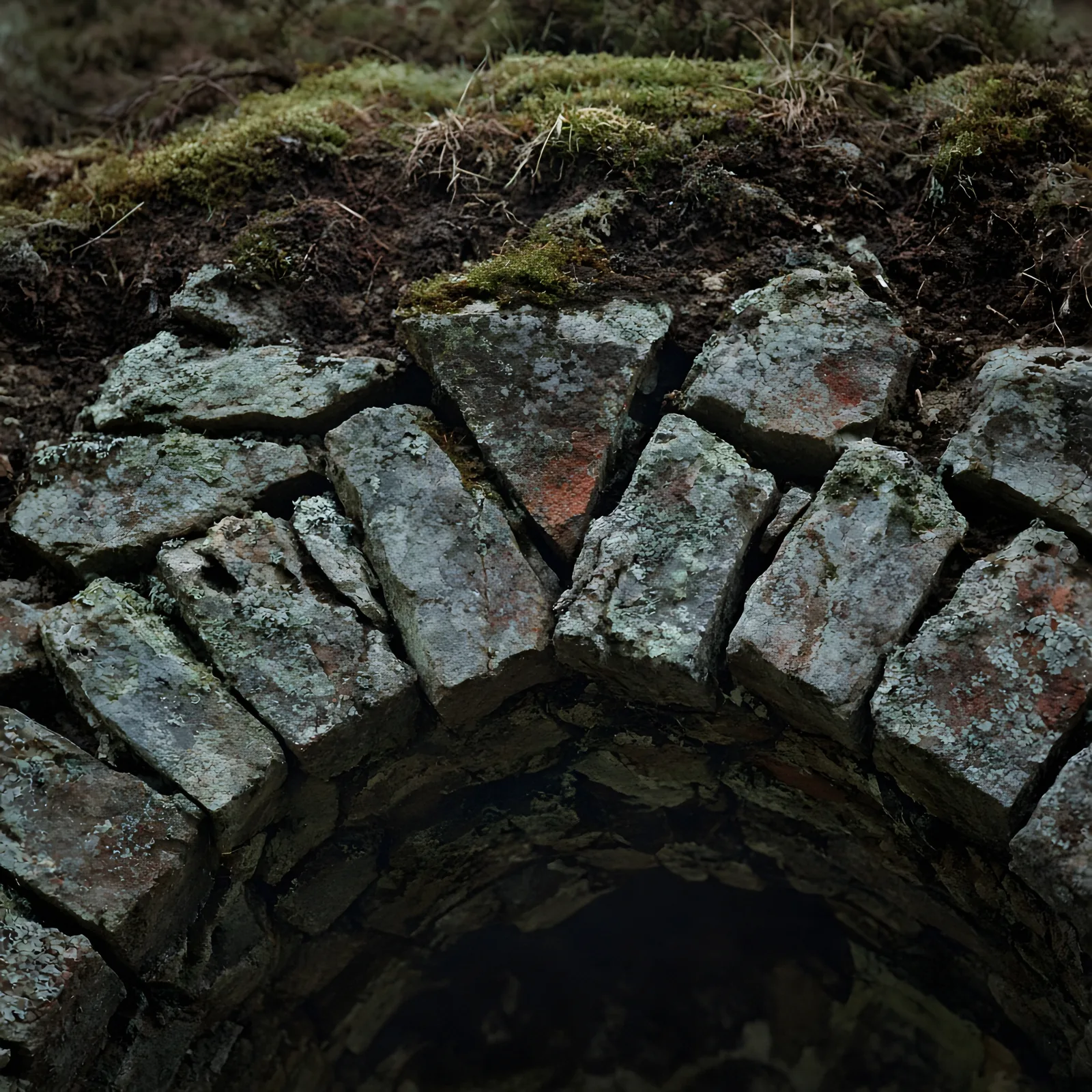
An arch has a curious property: a load from above can make it more stable. The stones press more tightly against one another, and a weight that might crush a different structure helps the arch hold together. Everything depends on the form.
This image has occupied me for a long time. What happens to a person when the environment begins to press down on them? Can you arrange your own action in such a way that external pressure does not merely get in the way, but gathers your attention, making it deeper and more precise?
Normally, people try to create suitable conditions for a tea ceremony. They choose a beautiful space, dim the light, and remove extraneous sounds. For a time, the world is cleared of anything that might interfere with the tea session.
I began to wonder what would happen if I did the opposite.
That is how the art project Performative Aesthesys took shape — a tea ceremony in an aggressive environment.
I brewed tea at a landfill with homeless people, on a commuter train, and on the front line as shelling began. Once, a friend and I held a tea ceremony right on the median strip of the Kharkiv Highway at night.

It was a quarter to midnight. We sat on a mat with a tea tray, a teapot, and cups between us. Cars rushed past to our left and right. At times the headlights blinded us; some drivers honked.
“Yura, picture an arch,” I said. “The aggressive environment is pressing down on you — and it will either break your practice or strengthen it. Weight into the floor! Move slowly, as if underwater.”
We drank tea, moving sequentially through the sensations of weight, touch, taste, aroma, sight, and hearing. At some point it felt as if the two of us had dived somewhere into the depths. Cars kept hurtling past right beside us, yet time flowed remarkably slowly.
And suddenly that spot seemed to me the safest place in the world.
When the ceremony ended and we began packing up our things, it got a little frightening. Waiting for a gap in the traffic, we made our way to the shoulder.
“Listen,” Yura said, “next time let’s just get coffee.”
What interests me in these works is not only the stability of attention. The environment itself becomes a participant in the ceremony. Sounds, light, movement, passersby — all of it enters into its composition. Sometimes it gets in the way; sometimes it offers an unexpected continuation. The tea master cannot be in complete control of what happens, but can answer it with their own form of action.
This is one of the qualities for which I love the tea ceremony as an art. It cannot be fully foreseen, even when you know the sequence of movements by heart.
Musical performance has an important quality: knowing the notes does not replace the sound. You can study the score, the composer’s biography, and the construction of the instrument in every detail — and still not hear the music itself. A performance unfolds in time, and that living time cannot be assembled out of information about it.
A similar difficulty arises with the tea ceremony. It is easy to describe as a sequence of operations: warm the teaware, place the dry leaf inside, pour in the water, decant the tea liquor into the chahai, hand out the cups. The description will be technically accurate and will say almost nothing about the quality of the event. Two people can carry out the exact same order of actions with the exact same tea — and in one case a whole, breathing space will emerge, while in the other it will be a mechanical procedure of pouring hot water.
The difference does not lie in some special secret of the master. It is built out of entirely tangible things: the pace of the hands, the placement and weight of a pause, the way the sound of the kettle coming to a boil changes as the water level drops, the way steam rises from warmed porcelain, how comfortable it is for the guest to sit, and how the host receives a stray sound outside the window.
When I first seriously encountered Chinese tea in 2003, my path began with learning the canon, the utensils, and the rules. Yet over two decades of brewing tea and hosting gatherings for all kinds of people, one thing became clear: the living center of the event lies not in reproducing a ritual protocol, but in how the time and attention of the people at the table are organized.
I view the tea ceremony, among other things, as an immersive performance. Here the participant does not watch a stage from an auditorium — they are inside the action itself: holding the cup in their palms, feeling its temperature and the density of the liquor in their mouth, altering the rhythm of the gathering through the pace of their sip. This artistic form exists in time and cannot be reduced either to a beverage or to a set of gestures. It is distributed among the tea, the water, the utensils, the space, and the people at the table.
Understood this way, the tea master is closer to a performing musician and a host than to the sole author of every experience that arises. They establish the conditions and the form, but do not dictate what another person will feel. Within the very same pause, one guest will feel calm, another the fatigue accumulated over the week, while a third will remember an unfinished conversation. These differences are woven into the fabric of the event, even if no one speaks them aloud. Just as after a good concert, people do not need to leave the room with the same report for the gathering to have been a success.
What, then, allows us to judge the quality of the work? Above all, the handling of the material and the proportionality of the form. Was the tea prepared attentively; did its taste and aroma open up? Did the movement of the hand grow out of the actual weight of the vessel and the task of pouring — or did it exist separately, for the sake of beauty before an observer? When objects are arranged comfortably, when the hand knows the balance of the teapot, and when a person does not try to finish a gesture before the water has finished pouring into the cup, clarity appears in the movements of its own accord. It needs no extra ornament.
A public setting always tests this clarity. The moment a spectator appears, so does the temptation to watch one’s own attentiveness from the outside. Fortunately, tea utensils are stubborn partners: the lid of a gaiwan does not become weightless because of an inspired expression on your face, a stream of boiling water does not wait for a graceful gesture to finish, and unfurling leaves demand that the water be poured out on time. The objects constantly return the performer to what is actually happening on the table. A tea ceremony has several scales of composition. A single sip has its own beginning on the lips, its fullness in the mouth, and the long trail of its aftertaste. Several successive infusions form a larger arc: from first acquaintance, through a dense middle, to the quiet, transparent tapering off of the tea. And the gathering as a whole — from the arrival of the guests and the arrangement of the space to the last cup — comes together as the overall form of the evening.
Mastery shows in how these scales are attuned to one another: sometimes the most technically brilliant infusion turns out to be superfluous simply because people are already tired and the inner form of the gathering ended five minutes ago.
In his book “Art as Experience,” John Dewey linked the aesthetic precisely to how the stream of everyday life gathers into an unfolded, internally complete experience [24]. The tea table makes the difference between a mechanical stopping point and an artistic completion especially clear. The result of brewing is the liquor in the cup; but the completion of the gathering comes a little later — when the last drop has been drunk, the sound of water has died down, and the things on the table no longer ask for a continuation.
In AESTHESYS TEA Practice [A2], we join the training of attention with the continuous artistic flow of a gathering: the host prepares the tea infusion by infusion, passes the cups to the participants, guides the group through the sequence of the seven focuses with voice and their own movement, and practices alongside everyone else. Discussion and questions wait until after the cup has been turned over.
From the standpoint of direct practical utility, such a gathering looks unusual: we have spent an hour, water, and good tea without producing a single durable object.
The cups are empty.
Not a bad start.
8. The Tea State

By the third infusion, the tea changes its handwriting.
The first met us with an open floral top note—almost weightless, volatile. The second gathered density and warmed the throat with warm bread crust and baked fruit. And now the tea in the cup has grown lighter and more transparent, yet from the bottom of the emptied porcelain rises a thick, deep scent that seemed absent from both the dry leaf and the first sips.
In the room itself, meanwhile, nothing special has happened. Someone shifted a numb leg and adjusted a cushion. A car hummed past outside the window. On the hot plate, the cooling water sang a little more quietly. Yet the gestures around the table have lost their angularity, the pauses between remarks no longer demand to be filled at once, and the edges of objects have acquired an unexpected, calm sharpness.
The cup turns out to have an exact weight, and this weight has a direction. The fingers meet the warm glaze, the palm receives the small heaviness, the shoulder drops slightly, passing it on into support. The tea touches the lips, spreads across the tongue, and its presence in the mouth continues even after the cup has returned to the table. In the silence, you can hear the last drop break away from the spout of the teapot into the chahai.
All these small physical events were happening half an hour ago as well. What has changed is not the room—what has changed is the fullness of our participation in it.
In the tea world, this has long been called the tea state. I use this word in a simple sense—the way I have described it above.
Over two decades of working with tea, I have encountered it in the most varied settings. Sometimes it arrived in focused silence, sometimes in the middle of a noisy late-night conversation in a kitchen. At times it brought a still, transparent calm, and at times a sudden laugh, tears rising to the throat, or a clear surge of vitality. This state has no obligatory facial expression, no canonical posture, and no single correct emotion.
Something else gives it away: a rare, almost tangible density of the present.
In the ordinary rush of the day, our perception works like a thrifty dispatcher. The taste of a morning drink is immediately crowded out by thoughts of the commute, the commute by an internal monologue, the monologue by a list of evening chores. Meanwhile, the hand dutifully lifts the cup, and the body carries it to the mouth without needing reminders, remaining an unnoticed performer.
At the tea table, this habitual hierarchy steps back. We begin to notice not only the thing itself, but also the air the hand passes through on its way to it; not only the completed gesture, but also the quiet impulse in the torso from which it begins; not only an individual sound, but also the volume of silence that holds it. Time ceases to be a narrow corridor between “already late” and “still have to get it done”—it acquires depth and its own breath.
In its nature and elevation, the tea state stands alongside what opens up to a person in great music, poetry, or prayer.
In a live musical performance, there comes a second when the listener stops registering the bow, the string, and the acoustics of the hall separately—the listener becomes the very place where the sound unfolds. A precise poem shifts our habitual angle of vision so that behind words familiar since childhood, an experience never before named shows through. Prayer, through a simple, rhythmic return of attention, gathers a scattered person into a whole presence.
A tea gathering works with very earthly matter—tea, boiling water, clay, temperature, a slight bitterness at the root of the tongue, steam, and human warmth. Yet out of this simple matter it builds a space of the same artistic capacity.
When we learn the practice step by step, at first we have to hold on to separate landmarks: slowing the hand, listening to our weight, drawing attention back from the fingertips to the center of the body, discerning the taste of the water and the trail of aroma. In the beginning, each element requires separate care.
Gradually, however, living bridges emerge between the separate channels.
The way you feel your weight in support changes the softness of your touch on the cup. The softness of touch naturally evens out the pace of the hand. At this unhurried pace, the aroma of the cooling bottom of the cup unfolds differently, while a wide, released gaze holds the entire room at once, allowing hearing to take in rustles and pauses as a single whole.
And at some point, the internal tuner is no longer needed. The individual focuses of attention stop requiring supervision and come together into a single, self-sustaining field of presence. The tea state grows out of attention to the smallest details, yet it is lived as an indivisible whole.
Especially interesting is its ability to spill over the brim of the gathering—what we usually call inspiration.
Often, after a good ceremony, precise, calm words suddenly appear for a conversation that had been put off for months. Sometimes an idea, a movement, or a visual frame is born. And sometimes you simply step out onto a familiar street—and see the bend of a branch, the light of a streetlamp on wet asphalt, or the face of a passerby with such pristine clarity, as if a cloudy film had been lifted from your eyes.
The tea state easily becomes a source of new action. Yet it is important to remember: it has no need at all to justify itself by these future fruits. Even if after the last cup you do not make a single fateful decision, the event lived at the table has already taken place as a finished work.
At the same time, inspiration is never issued by subscription. You can take an outstanding collector-grade oolong, set up the light and teaware impeccably—and simply have a warm, pleasant sitting. Or you can brew the most modest everyday tea on the edge of a work desk—and unexpectedly enter a piercing, ringing silence.
Toward the end of the gathering, the tea in the teapot unfurls completely and gives up its last, subtlest nuances. The tea liquor becomes almost transparent, like hot water from a spring with a light forest echo. The intervals between infusions grow longer.
No one at the table tries any longer to fill the pause with words or to hold back the departing evening. And in this bright, lived-in silence, it becomes completely clear that everything essential has already happened.
9. The Body We Are Already Here With

Pick up a cup while thinking about tomorrow’s difficult conversation. Most likely, your hand will manage the task with ease: your fingers will find the familiar shape, lift the right weight, and bring the rim to your lips. The conversation has not yet taken place, but it has already altered the depth of your breathing, slightly raised your shoulders, and made the taste of the tea almost imperceptible.
Now shift your attention to the cup in your hand. Notice: you have not just now returned to your body from some disembodied realm. Not for a single instant did you cease to be a body — while remembering, worrying, choosing words, and staring through the table. Something else changed: which side of what was happening became available to your perception and participation.
When people speak of the practice of presence, they often draw a sharp boundary between two worlds: bodily reality, which is always in the “here and now,” and mental space, where the past, the future, plans, and anxieties live. This image has pedagogical power — it immediately lets you feel the difference between a living sip and a story about a sip. Yet if we turn this image into a literal wall between body and thought, or try to trace all human difficulties to the evolutionary emergence of the neocortex, we split experience right where we were looking for connection.
Thought and imagination do not live apart from flesh: a memory changes the muscle tone of the face, and the anticipation of a meeting reorganizes today’s movement. That is why I prefer to speak of two distinguishable sides of a single human experience. As AESTHESYS understands it, the body is not a mechanism operated by an observer hidden inside, but the very site of our participation in the world — visible and tangible to others, and felt from within by ourselves [25]. The idea of a cup cannot burn you. A finger gets burned quite unmistakably.
At the same time, the popular phrase “the body always knows” also calls for a thoughtful approach. A bodily impulse may express an acquired skill, fatigue, anxiety, or the inertia of habit. The sensation itself is real, but its meaning still needs to be understood. Embodied attention by no means implies being locked inside one’s own skin. If I am so absorbed in observing my own back that I fail to notice my neighbor’s hand reaching for a cup, the circle of my participation in the situation has narrowed. The beauty of the tea table is that it naturally turns attention from the inside out: first you feel the pad of your finger against the warm porcelain, then the weight of your arm, the support of the seat beneath your pelvis, the edge of the table, the distance to the other person, and the shared rhythm of pouring. Through the sensation of the body, we open out to the room and to other people.
Presence does not have to look like a motionless posture with half-closed eyes. A person can be utterly collected and present when moving a hot teapot away from the edge of the table in a quick, precise motion — and almost absent while maintaining the most serene appearance. The criterion here is not the outward picture, but the responsiveness of action: noticing that the liquor has reached the right density and decanting it in time; feeling that your posture has grown stiff and shifting position before patience becomes the main content of the evening. Every body brings its own history and its own proportions to the table. A familiar teapot feels lighter in the hand than a new one of the same mass because the hand already knows its balance. And if someone finds it uncomfortable to sit on the floor or has to reach up to a high table, the reason may simply be the height of the furniture, not a lack of awareness. The method has its own precise structure, but living transmission always takes into account what movement is available to a particular person today.
Tea practice does not ask us to abandon analysis or memory. A scale helps measure out the leaf, past experience suggests the water temperature, the tongue discerns astringency, and the hand feels the weight of the cup. The beginning of practice is not an attempt to purge yourself of thoughts, but the moment when the living conditions of what is happening stop vanishing without a trace behind automatic habit. Then the cup regains its weight, the conversation regains its pause, and you regain the possibility of clarifying what exactly you are doing right now.
10. Together Without Justification

Sometimes a simple invitation to tea sounds almost awkward — you immediately want to attach a clear reason to it: to discuss business, introduce people, share a rare sample, celebrate an occasion. A reason makes the gathering explicable to a schedule. It also shields us from a direct question: is it enough for us simply to be together?
The phrase senseless togetherness — togetherness without external justification — deliberately leaves this question open. In English, “senseless” sounds even sharper — “meaningless” and even “unfeeling” — and for a book about the senses, this is a deliberate paradox: such togetherness has no external meaning, yet it is full of feeling. The Russian word “bessmyslennaya” (“meaningless”) is easily heard as “empty,” but what is meant here is a togetherness that does not need to justify itself by any external practical utility. The value of this hour does not depend on whether it yields a business decision, an agreement, or an important insight. If a good idea comes over tea, wonderful; if nothing comes of it except a quiet evening, the gathering loses none of its dignity.
The tea table creates a remarkably tactful support for such time. Sitting across from one another empty-handed and sustaining a conversation through continuous eye contact can be difficult even for people who are close — any pause quickly becomes too exposed. Tea offers a small shared task that does not absorb all of our attention: warming a vessel, receiving a cup, waiting for the tea to be poured, noticing whether a neighbor’s cup is empty. A shared object gives the eyes and hands a third direction: we can look at the water and the steam together while searching for the right words, or while simply wanting to remain silent.
In the language of AESTHESYS, this is connected to the understanding of co-being: we are physically involved in one another’s conditions prior to any words. One person moves the chahai closer to a neighbor, another holds a cup for a moment longer, a third speaks or smiles — and the shared situation has already shifted slightly for everyone. Participation begins where this mutual connection becomes noticeable within the action itself.
In group practice, when several people explore a shared slowed rhythm over the course of a session and pass cups to one another, as the facilitator I often experience a distinct sense of the group’s “shared body” — as though the space between us had grown dense and cohesive. Yet this experience does not require every participant to feel the exact same thing. From the very same tea, one person will become collected, another will relax, and a third will simply notice how exhausted they are from the day. Intimacy deepens when we do not need to prove the sameness of our inner states in order to remain participants in a single event.
Tied to this is a very practical ethics of hospitality: how easy is it for someone at your table to decline what is offered next? If refusing a sixth infusion requires lengthy apologies and a doctor’s note, the form of the gathering has already begun to crowd the guest. If, on the other hand, one can simply say “that’s enough for me” or ask for water, and this is accepted without questioning, the space is arranged with care.
The same applies to the choice of pace and silence. The speed of movements at the table imperceptibly sets the frame for everyone else: one can hurriedly rush through infusion after infusion, or retreat into such ostentatious slowness that the guests are forced to wait. Contact improvisation has a precise observation: when partners moving at different speeds meet, the slower one does not have to slow the faster one down — they can become a reliable living support for them, “like a tree for a monkey.” In the same way, at the tea table, the facilitator’s steady pace does not constrain the guests, but holds a shared space within which each person retains their own freedom. And if a gathering involves a specific arrangement of silence, this is agreed upon in advance: forty-five minutes of practice pass without conversation — only brief cues from the facilitator are heard, giving way toward the end to shared silence — and afterward people can talk if they wish. At the same time, every participant retains the right at any moment to speak up about discomfort, ask for help, or stop the practice.
Naturally, togetherness also rests on simple material details: a comfortable seat, a cup within easy reach, the absence of fear of spilling a drop onto an expensive tablecloth. Sometimes removing an overly fussy cloth from the table does more for the shared atmosphere than delivering a long speech about relaxation.
After the tea session, the table remains the same, and our tasks do not vanish on their own. Yet the hour we lived through had its own clear form: within it, people arrived, received cups, found or did not find words, listened to the silence. We had somewhere to come to and someone to sit with, without justification. For this evening, that was enough.
11. Time That Need Not Be Won

The tea in the cup grew cold while someone was answering messages. Nothing terrible happened: the liquor can be drunk cool, or fresh tea can be brewed. Yet in this small domestic scene, the familiar assembly of the modern day is already visible. One action is registered as a “task,” another is pushed into the background, then they trade places — and by evening it can be hard to remember where you yourself were actually present during those hours.
Modern technologies really can save time: find information faster, translate texts, map routes, take over the draft work. There is no point arguing with that usefulness. The difficulty lies elsewhere: a saved hour does not announce on its own what it ought to be devoted to. If productivity remains the sole measure of life, every freed minute immediately turns into an obligation to wedge a third task between two others. The speed of operations grows, while the sense of available time remains the same.
To prepare tea efficiently means getting the desired liquor with a reasonable expenditure of effort: setting a timer, arranging the teaware conveniently, making no superfluous movements. That is a useful skill, yet efficiency answers only the question of means. It will not decide for us whether we want to drink this particular tea, invite these particular people, or leave the evening open for unhurried conversation. Sovereignty over aims and criteria remains with the human being.
Imagine an ideal recommendation system. It remembers every tea you have liked before, takes into account your favorite aromatic notes, the season, and your budget, offering ever more accurate matches each time. At first this broadens your horizons. Yet at some point a risk arises of finding yourself inside a perfectly predictable corridor of your own past habits. Living taste, meanwhile, also develops beyond the exact hit: through a sample that did not yield at once and left a question behind, through an unexpected suggestion from a friend, or a chance cup in an unfamiliar place. A good tool helps you orient yourself, yet leaves you free to step outside the model.
Time at the tea table differs from the time of a work task above all because it gains nothing from acceleration. Water can be boiled faster, but the taste of a sip will not grow richer for being swallowed on the run. The psychophysics and neurobiology of time perception show that we have no single isolated “organ of time” like an internal stopwatch: the experience of duration and rhythm is assembled from the work of attention, emotional state, and bodily processes [27]. When movement is subordinated solely to the quickest result, its middle is compressed and slips past perception.
By slowing the movement of the hand in practice, we are not promising ourselves that from now on we will walk slowly down the street or work slowly. Quick reactions in conversation, behind the wheel, or beside a hot fire remain altogether necessary. Slowing down at the tea table does something else: for a time, it makes the very composition of an action discernible — how the hand separates from its support, how it crosses space, how it meets the wall of the cup and receives its weight.
In this unfolded movement a living pause is discovered — that brief gap when the hand has already begun its path, yet weight has not yet been transferred and the direction is easy to refine without struggle. I encountered the tempo of participation far beyond the tea table as well — during my work with Amnesty International in wartime. Changing one’s own tempo of movement and attention was one of the themes of our training sessions. I was preoccupied with the question of what remains at a person’s disposal when the conditions of an encounter and the speed of events are set by someone else, and the possibilities for controlling what is happening are sharply unequal. Sometimes keeping your own tempo helps you avoid automatically picking up someone else’s reaction, and notice a possible next move.
There is a whole range of human actions — listening to music, talking with someone close, walking down a street, drinking tea — whose value is realized only in the participation itself. They cannot be handed off to an intermediary with a brief report received in return. Freed time becomes genuinely human when we allow part of the day to exist without a pre-calculated benefit.
On the grid of a calendar, such an hour looks modest enough. Then again, it is not the calendar that has to live here.
12. What It Means to Cultivate Taste

The words “I like it” are quite enough to pour yourself another cup. For your own pleasure and a friendly evening, nothing more is required. Questions arise when we want to understand how our impression is put together and why one tea quickly grows tiresome while another makes us want to return to it for months.
Cultivating taste does not have to begin with correcting what already pleases you. It is far more fruitful first to listen for the structure of your own liking: what exactly draws me here — a bright floral aroma from the first second, the dense oiliness of the liquor, a warm bready roast, or a long aftertaste? If you linger a little beside your own “I like it,” pleasure turns out to have a form.
Suppose someone is drawn to a fragrant high-mountain Taiwanese oolong that greets them at once with an open floral and creamy note. Instead of declaring this brightness “simple,” you can set a second sample beside it — a more restrained medium-roast oolong — and compare what happens to both teas on the third and fifth infusions. Then, in the sample that at the first sip may have seemed merely “quiet,” mineral density, even warmth, and a returning aftertaste at the root of the tongue suddenly begin to stand out. The first preference has not vanished or turned out to be a mistake, yet the palette of available distinctions has grown noticeably wider.
The Greek word aisthesis is bound up with the capacity to sense and to discern. In the eighteenth century, Alexander Baumgarten built around it a philosophical program of aesthetics as the science of sensory cognition — long before the word “aesthetics” came to mean merely the attractive styling of things [28]. And back in antiquity, Aristotle in his treatise On the Soul explained the work of perception through the image of wax that receives the impression of a signet ring without the metal itself [29]. What matters for our conversation here is the independence of sensory experience itself: we are able to distinguish two liquors on the tongue with precision before we find a suitable concept for it. At the same time, the field of aisthesis includes more than the pleasant: a cup that scalds the fingers or the sharp, astringent bitterness of overbrewed tea also reports on the real conditions of the encounter, and to notice only what conforms in advance to an image of “refined enjoyment” would mean artificially narrowing one’s own sensitivity.
In speaking of cultivating taste, it is useful to distinguish three questions: what am I able to notice? how do I understand what I have noticed? and what do I consider valuable for myself? They are closely intertwined, yet not identical. A professional taster can finely register the smallest technological nuances of a batch without looking for artistic wholeness in a tea session. In just the same way, a person may understand perfectly well why a rare aged sample is prized by collectors, do justice to its complexity — and in everyday life sincerely prefer a simple cup of fresh spring tea.
In the Critique of the Power of Judgment, Immanuel Kant drew attention to the special position of aesthetic judgment: it cannot be proved by logical calculation, yet neither is it reducible to an indifferent “to each their own” [30]. When we brew a favorite tea for a guest, we usually want not merely to quench their thirst — we want to share the quality that has opened up to us. In that invitation, generosity and an unwitting risk live side by side: generosity opens access to an experience, while the risk lies in expecting obligatory agreement. A sign of mature taste is the ability to offer what you love without defensiveness: to prepare the tea attentively, give the other person time, and accept without offense their “not for me” or “I don’t quite get it yet,” without writing the divergence off as the guest’s mistake.
The same inner freedom is needed before expensive or celebrated things as well. When a great deal of money has been paid for a rare sample and a long story has been told around it, admitting to yourself that the liquor left you indifferent is not easy — the invested effort demands justification. Taste is formed in part through the right to honestly refuse what is complex when it finds no response in experience, and through knowing how to value a simple, exact thing that is clear from the first sip and yet is not exhausted when you return to it.
Finally, good taste needs a sense of proportion and a light touch of self-irony. The ability to finely discern nuances of water and porcelain does not oblige you to turn every dinner into an inspection of the environment. Sometimes it is fitting to compare in detail two harvests from neighboring slopes, and sometimes it is far more important to notice the warmth and generosity of the person who has poured you the most ordinary tea in a familiar household mug.
Tea practice does not confer ready-made qualifications in music, poetry, or architecture — in each art you have to learn its own language and material anew. Yet work at the tea table instills the very manner of an attentive encounter: the habit of pausing before judgment, discerning the parts and the whole, returning to the familiar, and allowing the material to alter our expectations. You do not need to hold the entire history of aesthetics in your head in order to notice one day: for some reason, I want to drink this liquor more slowly. Out of such a small distinction, taste grows.
Everything said so far concerns more than the cup. Before we move on to the work itself — to choosing tea, water, teaware, and the seven focuses of attention — it is worth gathering these questions into one direct statement about why a contemporary person needs a practice of presence at all.
Manifesto. From Productivity to Authenticity

When you begin to discern the taste of water and tea in earnest, a question soon awakens inside you that can no longer be contained within the limits of the tea table.
What else in my life do I swallow without looking, out of inertia? Which of my desires actually grew out of my own experience, and which were neatly packaged and handed to me along with someone else’s explanation of their prestige? And why does one quiet evening leave a living trace in memory for years, while dozens of loud, expensive, and impeccably organized events crumble into oblivion by the following week?
Thus, cultivating sensory precision imperceptibly grows into a re-examination of how we live at all. And here the private practice of attention runs up against the central nerve of our era.
For several centuries, humanity has built, with immense persistence, mechanisms capable of lifting the burden of routine labor from our shoulders. We have shifted onto metal and silicon the pull of muscles, the crossing of distances, the copying of things, the storage of archives, and the most complex calculations. Today, before our very eyes, artificial intelligence is mastering territory that human beings have long regarded as their inviolable citadel: working with words, code, analysis, images, and logical inference.
We have achieved unprecedented success in freeing human beings from the need to spend their lives on the mechanical production of results. Yet, finding ourselves on the threshold of this freedom, we have discovered in bewilderment that almost all our ethics, our system of education, and our measure of human dignity remain chained to the conveyor belt of productivity.
From early childhood we are trained to be functions—useful, fast, profitable, convenient to report on. We have grown used to justifying our right to a place in the sun by the number of tasks completed. Naturally, there is an honest joy of craftsmanship in work well done. Behind it in modern culture, however, a far harsher unwritten law has grown up: any hour of life is legitimate only insofar as it has been converted into a measurable product. We have learned to defend even our own sleep, a walk, or silence before our conscience as an “investment in restoring our resources for tomorrow’s push.”
And now a technology steps onto the stage capable of performing more and more operational and intellectual tasks faster and more cheaply than we can.
A question that once occupied only a few now rises to its full height: if bare efficiency ceases to be our main human trump card, what, then, does the value of our presence on earth rest on at all?
It seems to me that our very anxiety before this question shows how narrow a measure we have been using.
You can cut travel time to a third without ever asking yourself why you are going to that city. You can flawlessly optimize the schedule of a family dinner and not experience a single second of closeness at it. You can build a life as an exemplary project—and discover at the end that the whole time you were only preparing to begin living.
The fact that more and more computational operations are passing to machines does not devalue human existence. On the contrary, it opens up space for far more difficult and captivating work: to hear what we truly want, what we consider worthy of love, and with what participation of our own we wish to answer the world.
It is precisely this historical turn—from productivity to authenticity—that constitutes the chief challenge of our time.
Authenticity here does not mean searching for some isolated “true self” supposedly existing apart from culture, language, and other people. Our tastes, words, and attachments grow in relationship with the world [26]. What is at issue is practical authorship: the capacity to notice our own criteria for what matters, to test them against living experience, and to change direction when the old one no longer answers to what is genuinely important to us.
Human beings are given an astonishing double optics: we are able to be physically present in this room while simultaneously wandering in a vast invisible space of language, memory, hypotheses, and designs.
The skin feels the evening coolness—and in the very same second, memory unfolds a picture of a southern shore twenty years ago. The ear hears an interlocutor’s intonation—and the mind is already constructing three possible defenses. The hand holds a warm cup—and thought continues yesterday’s argument.
It is to this very capacity to detach from the immediate givenness of the moment that we owe science, law, poetry, cities, and the ability to ache at heart for people on the other side of the continent. Our existence is inherently wider than whatever is pressing against the retina right now.
Yet this gift has a dark double: disembodiment.
The inner screen of models and expectations becomes so dense that a person lives for years in a rough draft: postponing breathing until some future success, replacing a partner’s living face with their own fears, and barely noticing how their own days pass. In such hours we do not turn into pure spirits—we simply go blind to the overwhelming part of our own being.
European thought since Descartes has long struggled with this rift, trying to stitch the thinking “I” and extended matter back together. Today we need not blame old philosophy for all the crises of modernity, yet the Cartesian seam itself still runs straight through our everyday speech—every time we speak of the body as an external vehicle for the brain.
It is time to change the very language of description.
The body is not merely something we have. At the basic, primary level, the body is what we are [25].
This does not reduce a human being to physiology, nor does it cancel the heights of thought, memory, or spirit. The body is the visible, tangible, vulnerable layer of our existence. Here intention acquires the weight of an act, a word becomes a living voice, and the meeting of two people becomes an event.
Sensations are not rough noise at the threshold of reason, but the direct language of our connection with reality. And the capacity to finely discern these signals without falling into the trap of the first available interpretation requires as much cultivation as a command of language or mathematics. After all, not every spasm in the chest means a real threat, not every euphoria testifies that we are right, and not every habitual “I want” belongs to us ourselves. To feel is not yet to understand; but understanding severed from the living flesh of experience inevitably degenerates into servicing someone else’s schemes.
The skill of sensory discernment is the direct foundation of inner freedom.
Where even half a second of living gap opens between an external jolt and a habitual reaction; where you manage to notice your swing before your hand comes down; where the desire to please does not automatically turn into a nod of agreement—right there practical agency is born. To be free, a person does not need to command the weather or other people. It is enough to have command of one’s own presence and to answer for one’s next step.
And from this exact same point grows a mature ethics.
Popular culture in recent decades has taught us to jealously defend personal boundaries against outside intrusion. That is necessary hygiene, but it is only half the truth. A sensitive person sooner or later discovers the reverse perspective: how heavily we ourselves—with our speed, impatience, loudness, anxiety, or thirst to be right—press upon the fabric of the world around us.
First and foremost, boundaries must be set from within, protecting the world from oneself.
Each of us is already a message. Long before we open our mouths and utter the first sentence, our body, our pace, the way we entered the room and the way we set an object on the table have already altered the conditions of life for everyone present. We are conduits of meanings, yet not passive instruments of their realization: our human task consists precisely in discerning which states and which meanings we agree to give form to through our own life.
That is why we so urgently need spaces of senseless togetherness—togetherness without a utilitarian alibi. Music, dance, poetry, shared silence, a cup of tea. Islands of time where no one serves as an instrument for anyone else, and where closeness is not obliged to report back with a result.
AESTHESYS grows out of this position.
We turn to cultivating bodily and sensory subtlety not out of fatigue with progress and not in order to flee into the archaic. On the contrary: only a person well rooted in their own perception is capable of using the most complex technology without turning into its appendage. When calculation, search, and the generation of templates are taken over by algorithms, the measure of human stature becomes the quality of our living participation: depth of attention, precision of taste, courage of choice, and the capacity for co-being.
The tea ceremony provides an astonishingly pure, intimate laboratory for this work.
Its raw material could not be simpler: time and rhythm, weight and volume, depth of touch, the taste of water and tea, the breath of aroma, the light of the space, and the orchestration of silence. There is a repeatable form that allows you, day after day, to notice the subtlest shifts in your own state. And there is a living person across from you, whose freedom to feel differently you learn to guard as your own.
We do not drink tea in order to work better.
We drink tea in order to be more fully and clearly present in our own life, rather than merely reflecting upon it.
Perhaps very soon the questions that for centuries seemed the province of a few philosophers and poets will become an urgent necessity for every person. What kind of life do I want to live? With whom do I want to share its time? What meanings should take form precisely through me? And what am I ready to leave behind for the world?
The human future lies not in competing with our own technology, but in a deeper mastery of the human way of existing.
From productivity to authenticity. From the endless accumulation of possibilities to the freedom to choose which of them are worth bringing into being. And from talk about presence to the simplest action.
Let us heat the water. Let us choose the tea. Let us set the cups on the table.
Part IIIThe Practice of Tea
13. Choosing Tea
Your first tea for practice should allow you to engage in the practice itself. This sounds simple, yet it immediately rules out several unhelpful scenarios: a rare collector’s sample you are afraid to ruin; a tea of unclear origin that leaves you guessing; a finicky tea that demands all your attention in brewing; or an overly dense, heavy liquor after which you no longer want the next cup.
Take a familiar loose-leaf tea with a clean flavor you enjoy. If you do not yet have one, ask a knowledgeable merchant for a straightforward sample with a calm character and basic brewing guidelines. If you have never brewed loose-leaf tea before, simply drink it a few times first without any attention practice—so that the tea and the water become familiar. The absence of museum-piece rarity at the start of the path is a great advantage: you can return to the same tea again and again without turning every session into an exam.

Finding your bearings in the world of tea is easier with the classical division into six categories: green, white, yellow, oolong, red, and dark (which within the Chinese classification itself is called black—heicha). This is neither a ladder of quality nor a hierarchy of nobility, but a map of processing methods: six technological routes along which a tea maker guides the plucked leaf through heat, moisture, air, and time [31]. Good and poor examples are found in every one of them.
At the same time, the word “fermentation” is often used too broadly in the tea trade, grouping very different processes under a single name. In the making of oolongs and red teas, the key role belongs to the enzymatic oxidation of the sap inside the leaf upon contact with oxygen. In shu pu'er and other dark teas, microorganisms go to work in the presence of heat and moisture. For this reason, the six categories do not lie along a single straight line “from zero to one hundred percent fermentation” [32, 33].
Green tea (lücha) is subjected early on to heat in a hot pan or with steam: this fixation (shaqing) halts the activity of oxidative enzymes and preserves a spring-like freshness in the tea. Different ways of heating, rolling, and drying yield a wide range of shapes—from the flat leaves of Zhejiang Longjing, pressed by hand against the surface of the pan, to slender emerald needles or spirals. A good green tea is a fine place to explore the clarity of the first impression, the buttery density of the liquor, and notes of toasted nut, pumpkin seed, young greens, or sea air. These are possible directions for attention, not a checklist of mandatory findings: if a vendor promised you chestnut in the flavor and you do not taste it, there is no need to construct a chestnut through an effort of imagination. The main thing with green tea is not to mistake delicacy for under-brewed water, nor to mistake water that is too hot and a steep that is too long for coarseness in the tea itself.
White tea (baicha) follows the most concise sequence of operations: withering and drying with minimal mechanical interference in the leaf’s structure. Behind this outward simplicity, however, lies the precise calculation of the maker, who chooses the balance of air, heat, and time according to the weather. White tea is made from different grades of leaf: not only the tender, silver-downed buds of Baihao Yinzhen, which give a pale, almost weightless liquor, but also pluckings of bud and leaf (Bai Mudan), the more mature Shou Mei, and aged pressed forms that over the years develop a thick honeyed, herbal, and balsamic profile. For cultivating sensitivity, white tea is compelling because it teaches you not to demand a loud effect from the first second: let the cup cool slightly, and volume, softness, and a long aftertaste open up within its apparent transparency.
Yellow tea (huangcha) is close to green, but after heat fixation it undergoes a special stage of warm smothering (“yellowing”): the hot leaf is wrapped in thick paper or cloth, which removes the grassy sharpness and brings out a velvety, baked-milk softness. A beginning practitioner does not need to hunt down a rare yellow tea simply to complete a collection. Yet if a clean sample comes your way, it is fascinating to compare it with a green tea and notice how a single shift in the sequence of processing alters the density and character of the liquor.
Oolongs (wulongcha / qingcha) occupy a vast field of possibilities at the intersection of partial oxidation, varied leaf material, withering, bruising of the leaf edges, fixation, shaping, and subsequent roasting (hongbei). Entirely dissimilar worlds live side by side within this category. In Taiwan, the Tea and Beverage Research Station (TBRS) distinguishes strip-style, lightly oxidized baozhong; light high-mountain oolongs rolled into half-spheres (for example, from the Qingxin and Jinxuan cultivars) with their high floral-creamy profile; more heavily roasted traditional oolongs; and the honey-fruity Dongfang Meiren (“Oriental Beauty”), whose raw leaf is pierced on the bush by tiny leafhoppers [34]. In Guangdong, in the Fenghuangshan mountains near Chaozhou, makers produce dancong—“single bush” teas with a vivid orchid, almond, or citrus vertical. And in northern Fujian, in the gorges of Wuyishan, rock oolongs (yancha) are born, carried through a long charcoal roast: in them, mineral composure, warm stone, tree bark, and deep fire come to the fore.
Ball-rolled Taiwanese oolong shows especially clearly that dry volume and actual leaf weight are two different things. A small handful of tight green pellets, barely covering the bottom of the gaiwan, unfurls by the third infusion into whole shoots that fill the vessel to the brim. Here a simple pocket scale proves a modest and reliable safeguard against needless guesswork.
Red tea (hongcha) is named in the Chinese system for the coppery-amber and ruby color of its liquor, whereas in Europe it came to be called black tea after the color of the dry leaf. Here the tea undergoes deep enzymatic oxidation before drying. If you grew up in a culture of tea with sugar or milk, a good loose-leaf red tea—a honey-and-bread Yunnan Dianhong, a pine-and-fruit Fujian Xiaozhong, or a berry-like Taiwanese red—may be the most natural entry into the practice. Try brewing it without additions and not too strong: against a familiar warm backdrop, the natural sweetness of the liquor, its velvety texture, and the long warm trace left in the empty cup become immediately noticeable.
Dark teas (heicha) and pu'ers involve techniques in which microorganisms work with the tea and with time [35]. Among pu'ers, it is important from the outset to distinguish two technological paths: sheng pu'er (a Yunnan tea that is green in its primary processing and slowly matures and transforms in the course of natural storage) and shu pu'er (which undergoes accelerated wet-piling fermentation—wo dui—yielding a dark, thick, woody-nutty liquor). A young sheng, with its ringing astringency, apricot-meadow freshness, and swift returning sweetness (huigan), and a mature aged sheng, with its camphor, autumn-forest breath, offer very different experiences. At the same time, it is important not to confuse the deep earthy-woody profile of a well-made shu or aged sheng with the smell of a damp cellar and mold: the word “aged” does not turn spoiled storage into a virtue.
When beginning your work in AESTHESYS TEA Practice, it is simpler to choose a pure tea without added flavorings—this makes it easier to follow how the tea itself changes from infusion to infusion and how the aroma lives at the bottom of the cooling cup.
Linking the choice of tea to your own inner state is best done through observation rather than ready-made prescription charts. Tea contains caffeine and many other compounds; how the body responds to it—with alertness, composure, warmth, or excess agitation—depends on the variety, the dose, the time of day, and whether you have eaten before the tea session. If a particular liquor leaves you uncomfortable, there is no need to declare this a “mandatory stage of energetic opening”—simply reduce the strength, change the tea, or drink some water.
A small supply of one clear, well-stored tea for practice often proves more valuable than a dozen disparate samples. Once the material becomes familiar, it acts like a steady shoreline against which the shifts in your own attention and state from evening to evening show up more clearly. In this way, classification fulfills its task—helping you choose and prepare the encounter—and steps aside once the cup is in your hands.
14. The Instrument and the Method of Brewing
A teapot has a spout, a handle, a lid, and countless ways of getting in a person’s way. The spout may pour past the cup or send a stream dribbling down its own wall, the lid may slip at the worst possible moment, the handle may burn your fingers, and the internal strainer may hold back the water just when it is time to decant the liquor. For that reason, getting acquainted with teaware is best begun with how it behaves in your hand, leaving the potter’s biography for later.
Pour room-temperature water into an unfamiliar teapot. Lift it with your natural grip and pour the water into another vessel. Watch where the stream forms, how easily it can be directed, and how cleanly it cuts off at the end. Does a last drop cling to the spout? Do you have to twist your wrist sharply to empty the pot completely? At what angle does the lid lose stability? This brief trial with cold water tells you more about the tea sessions ahead than the most eloquent catalog description. Hot water should never be the teacher of the first lesson.
A musician chooses an instrument not only by how it sounds in the hall, but also by how it responds to the movement of fingers and bow. In the very same way, teaware offers the hand a specific relationship between effort and result. A comfortable vessel quickly grows into bodily memory: the hand knows its center of gravity in advance, and the movement stops breaking into tiny corrective adjustments. Habit, it is true, has a flip side: we can adapt for a long time to an awkward object without noticing the extra tension in the shoulder, until one day we pick up a better-balanced vessel.

For a session you will need very little: a brewing vessel (a small teapot or gaiwan), an intermediate pitcher for decanting, a small cup for tea, a small cup for water, hot water, and a cloth or towel for stray drops. The intermediate vessel is called a chahai (“sea of tea”) or fairness pitcher (gongdaobei, “cup of fairness”). The finished liquor is poured into it completely from the brewing vessel to halt further extraction and even out the strength of the drink before it is poured into the cups. The name “cup of fairness” holds an exact social metaphor: every participant receives liquor of the same strength. Still, fairness at the table goes beyond an even pour—a guest who wants no more tea today deserves no less attention.
A small cup allows you to meet the taste, aroma, and changing temperature of the tea many times without drinking a large volume of liquid each time. A thin porcelain rim gives one quality of contact with the lips; a thick ceramic wall gives another. These nuances are rewarding to explore, though at the start it is enough to check the basics: the cup is comfortable to hold in the fingers and pleasant to drink from. In group practice, the host passes the cup to the guest on a small wooden saucer: this protects the fingers from heat and makes the moment of passing from person to person a distinct shared action.
The gaiwan—a bowl with a lid and saucer—is a wonderful instrument for watching the leaves unfurl and for quick, clean decanting. Its possibilities open up alongside the skill of the hand. If you are just learning to use a gaiwan, practice first with cool water: find a steady grip by the rim or with the saucer, leave a small gap under the lid, and do not fill the bowl all the way to the top. Yet if the gaiwan still brings anxiety about burning your fingers or dropping the lid, there is no need to turn the practice into a struggle with the teaware—a teapot with a comfortable handle takes nothing away from the depth of attention.
Glazed porcelain and glass are convenient for their neutrality, the cleanliness of their surface, and the clear view they offer of the liquor’s color. Porous unglazed ceramics—Yixing, Chaozhou, Jianshui—retain heat differently and call for greater care in selection and maintenance. Stories claiming that a certain clay by itself invariably “rounds out” or “transforms” any tea should always be tested by side-by-side comparison: the shape of the vessel, the thickness of the walls, heat capacity, pouring speed, and the drinker’s own expectation are all working together here. After a tea session ends, any vessel should be emptied of spent leaves, rinsed with clean hot water without scented detergents, and left to dry with the lid off. A “teapot’s memory” is no reason to leave wet leaves sitting inside it until next week.
Now for the water, which makes up nearly the entire volume of the cup. If the water is unpleasant to drink on its own, tea will rarely fix the situation.
The mineral composition and hardness of water noticeably affect how compounds are extracted from the leaf and how the aroma opens up [36]. In the beginning, though, there is no need to turn choosing water into a complex chemical investigation: simply taste the soft drinking water you have on hand, warm, from an empty cup, and then compare two different waters with the same familiar tea. Brewing takes shape at the intersection of five variables: the amount of dry leaf, the volume of water, its temperature, the steeping time, and the speed of decanting. If you change everything at once, the result may be curious, but understanding the cause of the changes will be impossible. For your first short infusions, you can try a simple benchmark: four to five grams of a familiar red tea or oolong to 100–120 milliliters of water at around 90 °C, with a brief first steep and subsequent adjustments to taste. This is a starting point, not a universal recipe. Official guidelines from Taiwan’s Tea and Beverage Research Station offer other brewing methods as well, depending on the type of tea and the purpose of preparation [37]. If the liquor turns out too sharp and astringent, shorten the steeping time on the next infusion; if the taste seems pale, let the water stay with the leaves a little longer.
The very structure of AESTHESYS TEA Practice is of fundamental importance: the tea is brewed directly in the course of the practice, not prepared in advance. Two structures live here simultaneously. The first is the tea structure: warming the teaware, brewing the tea in short infusions, decanting into the chahai, passing the cup, taking a sip, listening to the aroma of the empty cup, and making the next infusion. The second is the structure of attention: moving sequentially through the seven focuses and bringing them together. They do not split into two separate activities, nor are they tied to a rigid “one infusion—one focus” scheme. In the original group format, the host continues brewing tea in the gongfu cha manner throughout all forty-five minutes: the tea gradually opens from cup to cup, the temperature, density, and aroma of the liquor change, and the host’s own movements with the kettle, water, and chahai enter the shared slowed rhythm and support the group.
At the start of a gathering, the host introduces participants to the dry leaf in a chahe (an open vessel for dry tea leaves), brews the first infusion, and serves the cups. The first sips and the encounter with the aroma belong to the tea structure even before the dedicated focus on taste. New cups then appear as the session unfolds, whenever the tea and the rhythm of the gathering call for them. In the fourth focus, we will return to the familiar act of drinking, but explore it in a new way.
If you are practicing on your own, you adapt this group form for one person: first, with ordinary clear sight, prepare the first infusion and pour the liquor into the chahai and cup. When it is time to make the next infusion, return to ordinary visual clarity, brew the tea, decant the liquor, and continue moving through the focuses of attention.
Prepare the space before you begin. Clear the table of extra objects and cords, set the kettle or thermos of hot water on a stable surface out of the way of your elbows, and leave open space around the cup and chahai. Sit on a comfortable chair or on a cushion that supports the pelvis—your back and legs should not have to prove the seriousness of your intention through endurance. And keep one simple safety rule throughout all the chapters that follow: exercises with closed eyes or a defocused gaze are done only while the hot vessels are resting on the table.
Look at the prepared space. Here you have water, tea, teaware, steady support, and forty-five minutes from which no immediate account is required. Now you can stop improving the setting and begin to practice.
15. Being in Your Own Time

Be in your own time.
Try bringing the cup to your lips a little more slowly than usual. Not solemnly, and not putting on a ceremony—simply so that the movement itself has time to become noticeable.
You will discover at once that a gesture has a beginning we easily miss in everyday life. Your hand is still resting on the table, yet already preparing to rise; the cup is still motionless, yet your gaze has already found its rim; your torso and shoulder have slightly shifted their position in advance. We are used to recognizing an action by its outcome: picked up, drank, set down. Yet a vast part of the encounter takes place before the result.
In the first focus of AESTHESYS TEA Practice, we explore our own rhythm by slowing movement down. To begin, leave the cup on the table—you do not need to hold anything in your hands. Slowly draw your empty hand through the space in front of you. Imagine a strand of seaweed underwater, or a drop of ink gradually spreading in a clear glass of water. These images have an important virtue: they suggest continuity of movement without issuing a rigid command to each individual joint. Seaweed is not trying to meet a standard of smoothness—it changes position as a whole, in accord with its medium.
Choose a pace that is perceptibly slower than your habitual one, yet remains comfortable for you. Feel how your hand begins its path, how it continues through the air, how it changes direction as the palm turns. Here it is easy to start monitoring the picture from the outside: whether your fingers are arranged gracefully enough, how your face looks. But the subject of our inquiry is accessible from within: how the movement flows, where it lingers, how effort is distributed.
Slowing down almost always reveals a curious detail. A familiar movement that seemed seamless at ordinary speed suddenly begins, when slowed down, to feel like a series of tiny steps—microscopic pauses show through between positions of the hand. This is a well-known phenomenon: slow movement of the fingers is composed of tiny pulses, roughly eight to ten per second [38]. There is no need to treat this as a mistake. Try playing with this sensation: slow down a little further, look for a viscous continuity inside the movement, and then return to a slow pace that feels comfortable to you.
Recall the moment just after waking, when you want to stretch and gradually enter your own body, before any thought of doing it faster or more efficiently has arisen. In a morning stretch, the body moves as a single continuous stream. In the practice, we look for that same inner naturalness while keeping clear attention on objects and space.
Now carry the rhythm you have found over to the tea. In group practice, the person leading the session brews the first infusion in this slow time, pours the tea liquor into the chahai, fills the cup, and smoothly passes it to you; in solo practice, with your eyes open, you yourself take up the chahai with the first infusion already prepared, pour the tea into your cup, and return the vessel to its place. Let that same unhurried pace run through the entire sequence: the hand reaches out, meets the surface of the vessel, receives its weight, changes its tilt, returns the object to the table.
Especially interesting is the moment when you set the cup or chahai down on a surface. In daily life we often stop participating in a movement a fraction of a second before the object has found its support: the base has not yet touched the wood, and attention has already leaped ahead to the next task. Here, wait for the full meeting of the base with the table, feel that the surface has taken the entire weight of the vessel, and only after that release your fingers. The time of the action immediately becomes fuller.
Throughout the rest of the session, this slow rhythm remains a continuous background. If you feel like adjusting your clothes, shifting your posture, scratching, or touching your face—do it at the same slow pace. This exposes our habit of dividing time into "front-stage practice" (when the hand holds the cup beautifully) and "backstage" (when a person shifts a numb leg with a quick, abrupt movement). Yet the leg is in the very same room, and its movement belongs entirely to the session. If you notice that you have imperceptibly slipped back into ordinary everyday speed, simply slow down again. As I say in sessions, there are no fails here: the very moment you notice the acceleration is the point of practice.
Sometimes you may notice an amusing discrepancy: the hand moves slowly while the head keeps galloping ahead: "Fine, I agree to move slowly, but let's hurry up and get the enlightenment we were promised!" Out of habit, we want to order even calm with express delivery. There is no need to fight this impatience. It has its own bodily side: a turn of the head that begins slightly too early, the next gesture already prepared, tension in the shoulders. Simply noticing these signs is enough—and the material of practice only grows richer.
And when you truly manage to stay at your own pace, a remarkable subjective experience arises: it begins to seem as though the surrounding world itself is gradually adjusting to your speed. The physical clock on the wall goes on as before, yet inside the action the rush of pursuit disappears: the hand has already reached toward the cup, but has not yet closed around it; the cup is already lifted, but not yet tilted. Between intention and completion, an accessible space of choice opens up.
Set the cup on the table and feel the surface supporting you. Keep the rhythm you have found as a background. The next question will be even simpler and more unfamiliar: how do you weigh right now? Not how many kilograms, but how, exactly.
16. Weight and Volume

Sense your weight and limits.
When asked about our weight, we usually answer with a number. Yet the number on the scale says nothing about how you are sitting right now: whether those kilograms rest freely on their support or are held up by the unnoticed work of your shoulders, neck, and lower back.
In everyday life, we remember weight when we have to carry it—a heavy bag, a child in our arms, a backpack on an uphill climb. At the tea table, you can explore the opposite situation: most of the necessary support is already provided. The floor and the seat hold the body, and the task is to make this connection accessible to sensation.
Set down your cup and free your hands. Keeping a slow rhythm, imagine that your weight begins to melt like a wax candle and gradually flows down through your body into the floor:
— the weight of the head — flows into the chest and shoulders; — the weight of the chest — settles into the belly; — the weight of the shoulders — passes through the elbows into the hands; — the weight of the belly and the weight of the legs — gather in the pelvis; — and all the gathered weight of the body continues downward — through the seat and the feet into the floor.
Move through this sequence unhurriedly, leaving time for each transition. The image of a melting candle helps you feel a redistribution of involvement rather than asking you to go limp or slouch: you continue to sit steadily and upright, your breathing remains free, and the body simply stops holding up what is already supported. Now slowly raise one arm above the table or your knee. Feel its weight against the background of the rest of your body. There is no need to estimate it in grams—the question remains the same: how does it weigh?
When you take a familiar bag of sugar from the kitchen shelf, your hand is prepared in advance for a certain effort—that weight already lives in your muscle memory. If a piece of lead were suddenly inside that same bag, the difference would reveal itself instantly, before any calculation. With your own arm it is harder precisely because it is always with you, and its familiarity makes it almost invisible. Stay for a few moments with the weight of your raised arm, then lower it smoothly. Try the other arm. Feel the weight of your head, and return once more to the overall weight of the body flowing down into the floor.
Next, attention moves from weight to internal distances and volume. Gently close your eyes. Imagine a fine thread stretched through your head between your two ears. How long is it? Here too, an answer in centimeters is not needed—try to feel the internal distance itself, as though you could show it between your palms. Gradually, without rushing, trace other internal threads with your attention:
— between the right and left shoulders; — between the elbows and between the wrists; — between the two pelvic bones; — between the knees and between the heels; — and finally — the long vertical thread from the crown of the head to the tailbone. There is no need to deliberately stretch or tense the body for the sake of ideal geometric symmetry—each distance belongs to the living posture in which you are sitting right now. If one area is felt distinctly while another remains hazy for now, do not fill it in by force; simply linger beside it.
From individual lines we move to flat and three-dimensional figures. Imagine an internal triangle between your two pupils and your navel. Stay with the mutual arrangement of these three points, linking head and torso into a single field of attention. Next, build a horizontal square between the collarbones and the shoulder blades in the upper part of the rib cage: the two front supports are the sternoclavicular joints; the two back supports are the upper inner corners of the shoulder blades. Sense the width and depth of this internal figure—it immediately helps you feel the rib cage as three-dimensional.
Now turn to volume itself. Imagine your head as a spacious balloon and feel its volume from within. Then sense the single combined volume of the chest and belly together. The volume of both arms together. The volume of both legs together. Move your attention gradually, giving each area time to emerge before naming the next.
Take five breathing cycles in your natural rhythm. On each exhale, imagine that you are breathing out through the entire surface of your skin at once in every direction—as though your body were breathing like a sea sponge. Let this image gather the separate distances and parts into a whole sensation of the body’s volume in space. And now unite this discovered volume with the sensation of your own weight. How I weigh. What volume I occupy. This is what I am physically. Stay with this combined sense of the center of weight and volume—it lies in the pelvis. This visible and tangible layer of existence does not exhaust the whole human being—we still have memory, language, intentions, and relationships—yet the body ceases to be merely an unnoticed vehicle for delivering the head to the table.
Slowly open your eyes, allowing the sense of weight and volume to remain with you. The word “limits” at the beginning of this chapter points to a very simple thing: the sensation of your own extension, the boundaries of your body, and the distance to the objects around you. And now, keeping access to this internal whole, you can reach out your hand and explore the very quality of meeting a thing.
17. Touch from the Depths

Touch from the depths.
A cup can be picked up as if it already belongs to the hand: the movement knows its ending in advance, the fingers fold into a grip as they approach, and the porcelain wall serves only as confirmation. But you can meet the object differently: first touch it lightly, let the surface appear in sensation, and only then receive its weight. Outwardly the difference takes an instant, yet from within these are two different actions.
In the third focus of TEA Practice we explore the connection between the very periphery—the point of contact at the fingertips—and the center of our weight and volume. We do not simply relax the hand or reduce the task to the convenient biomechanics of a grip; we change the very organization of attention: the point of contact remains at the periphery, while the action itself is experienced from the center of our own body.
To find the measure of the lightest possible touch right away, close your eyes and slowly bring your fingertips to your own closed eyelids. Eyelids are very sensitive—without any explanation, they show the hand the boundary between contact and pressure. Offer the lightest touch you are capable of: make sure that contact has truly taken place, feel the warmth and the thin skin of the eyelid, yet leave the eye beneath it in complete stillness.
Stay with your attention in your fingertips. And now, leaving your hands where they are, begin to step back gradually with your attention into the depths of the body:
— from the fingertips into the hand; — from the hand into the elbow; — from the elbow into the shoulder; — and further, into the center of your weight and volume. Give each transition its time. The touch has remained at the periphery, in the fingers, yet you try to sense it from here, from the center. Feel the connection between them and try, through your attention, to make the touch lighter still—as though extra space that was not there before were opening up beneath the pads of your fingers.
Return briefly with your attention to the fingertips—and again step back into the center of your weight and volume, leaving the touch in place. Play with this transition a few times without hurry. A simple everyday image helps here: when you fish a potato out of soup, you take the potato, yet your hand holds the handle of the spoon. The place of contact and the place from which you act are set apart, yet they form a single seamless event.
Try touching your face or the fabric of your clothes with other fingers, then slowly open your eyes and touch a surface beside you—the table, a rug, the floor—first with your fingers and then with your whole palm. Each time, repeat the same transition: touch lightly, and step back with your attention into the center of your weight and volume.
Now let us carry this way of meeting over to a cup of tea. In group practice, at this moment the host brews a fresh infusion, pours the liquor, and extends the cup to you on a wooden holder. This is a special action—passing the cup from center to center: the host holds the holder from their own center of weight and volume and attunes to your movement, while you slowly guide your hand to meet it. If you are practicing on your own, your support is the table on which the warm cup rests.
Slowly reach out your hand and at first only touch the cup—as if glued to its surface. Feel its temperature, texture, and shape. Without lifting the cup, step back with your attention along your arm into the center of your weight and volume. Then settle the cup comfortably in your hands and slowly receive its weight from the wooden holder or from the table.
I put it simply: “take the cup with your center”—receive its weight from the center of your body. Your hands hold the porcelain securely, yet the small weight of the cup does not get caught in the fingers or the wrist: you receive it against the background of your own weight and volume, just as earlier you felt the weight of your raised arm against the background of your whole body. Imagine the weight of the cup passing through your hands, through your torso, and flowing down into the floor, into your support.
Stay with the cup in your hands. When you set it back down on the table, do so just as slowly: feel the moment when the surface fully receives the weight, allow it to find its new support, and only then release your fingers.
Now widen your sensitivity to the touches in which your whole body is already taking part: feel the surface you are sitting on, the contact of clothing against your skin, and even the touch of still air against the exposed areas of your face and hands through the difference in temperature. If you feel like shifting your posture or stretching, flow smoothly into a new position, open your mouth slightly, release your jaw, and continue to feel your weight and the touches.
Take the cup again: touch it, step back with your attention to the center, receive its weight into your support. Next, at the threshold of the lips, touch will meet taste.
18. Knowing the Taste of Water

Know the taste of water.
Water enters the conversation about tea almost unnoticed. People usually ask about the name of the bush, the age of the tree, the harvest year, and the maker, forgetting about what makes up ninety-nine percent of the contents of the cup. Attention has a habit of looking for the exceptional and overlooking the simple foundation that allowed the exceptional to appear at all.
That is why the fourth focus begins with water. Take a sip of clean warm water from a separate cup—in the same way you will later drink the tea. It is easy to notice that the absence of a vivid aroma does not mean the absence of taste. Water has temperature, density, softness or dryness, the character of its touch on the tongue, and a trace after the sip. The reminder “know the taste of water” keeps us in contact with the simple act of drinking—even when what is in the cup turns out to be a rare and complex tea.
After the water, let us turn to the taste of the tea. In group practice, the facilitator pours the next infusion and hands you a cup; in solo practice, you pour a small portion of tea and let it cool slightly to a comfortable temperature. Pick up the cup, keeping a light touch and a sense of your own weight and volume.
And now do what your mother may have forbidden you to do as a child: drink the tea with a loud, distinct slurp. Bring the cup to your lips and briefly draw in a small sip of the liquor along with air so that it makes a loud sound. Engage your lips and cheeks; let them move freely. In a live session, the invitation here is: “The scarier, the better.” A smile, laughter, and surprise are entirely in place here: tea has enough dignity of its own to survive a cheerful sound.
This action immediately releases the tense, overly cautious manner in which people sometimes drink “serious” tea: a tiny sip, nearly closed lips, an intent face. Spread the tea throughout your mouth, as if rinsing it. Feel how the liquid simultaneously touches the tongue, the palate, and the inside of the cheeks. (If taking a sip with air is uncomfortable, drink in the ordinary way while keeping full contact in the mouth.)
While the tea is in your mouth, stay inside this sensation completely. Do not rush to divide it into parts or look for words right away—the time for names and descriptions will come later. In what we call by the single word “taste” in ordinary speech, a whole ensemble is always playing: the gustatory qualities of the tongue itself (sweet, bitter, sour, salty, umami) combine with temperature, the tactile density of the liquid, astringency, and the aromatic compounds that rise from the oral cavity to the olfactory region through the nasopharynx—what physiology calls retronasal olfaction [39, 40]. Scientific knowledge helps us avoid confusing these processes, but the living sip can be left in its wholeness.
Swallow the tea. Slowly lower the cup and give yourself a little time.
In this pause after the sip, the most interesting part often unfolds. The liquid is no longer in the mouth, yet the impression continues to change: the initial astringency or slight bitterness recedes, coolness or returning sweetness appears, the sensation at the root of the tongue and in the throat shifts. There is no need to demand the same sweet aftertaste from every tea or to immediately grade the liquor “like / dislike.” Between the first impression and a ready-made judgment, it is useful to leave a little air—to let the tea finish its sentence.
Finish the cup at the same unhurried pace. Then bring the emptied warm cup to your nose and breathe near its inner surface: let both the inhalation and the exhalation pass through the open space of the cup. We intentionally turn to the aroma after the sip, continuing the encounter with the liquor that has already begun. Notice whether your perception of the aroma has changed after the exercise with taste. With this empty cup at your face, we move on to the next focus.
19. Breathing with Your Whole Self

Breathe with your whole self.
You cannot hold a scent before you as steadily as your gaze holds a cup on the table. Aroma appears and departs on its own terms: if you start drawing air into your nose too eagerly and sharply, trying to sense more, tension quickly builds in your face and shoulders, and perception itself grows dull. Here the difference between a readiness to meet and a demand for a result is especially clear.
In the fifth focus of AESTHESYS TEA Practice, we continue working with the warm, empty cup from which we have just drunk the tea. Your breathing remains natural and even; the cup is held near your nose so that both inhalation and exhalation pass effortlessly through its open space.
First, stay with the aroma you can sense right now, without trying to find a name for it. From here on, the cup stays the same, while with the help of imagination we shift the angle of attention step by step—imagining that we are breathing with different places in the body:
— imagine that you are breathing with the very tip of your nose—direct your attention there and breathe for a while, sensing the aroma; — then try breathing with the wings of your nose, and give yourself time to sense the aroma from there; — next, with the base of your nose, leaving time between transitions for the sensation to unfold;
— then try breathing with your throat and rest your attention there; — move your attention into your chest, imagining that you are breathing from there; — and finally, return to the familiar image from our work with weight and volume: imagine that you are breathing this aroma with your whole body, with the entire surface of your skin, like a sponge. Of course, physiologically the air continues along its usual path—the images of "breathing with the chest" or "breathing with the whole body" serve as a way to reconfigure the angle of attention. Yet as this inner point of support shifts, the experience itself often changes too: the aroma ceases to be perceived as an isolated signal in the nose and unfolds against the background of the body as a whole.
Retrace the entire path in your memory: the tip of the nose, the wings, the base of the nose, the throat, the chest, the whole body. Where did the aroma unfold for you the most? Return your attention there and remain for a while. You may continue breathing through the cup, or slowly set it down and stay with the sensation that has arisen, releasing the focus and returning to it again. And if all the points felt equal today, there is no need to artificially pick a winner.
Sometimes, during such breathing beside a cooling cup, a sudden image from memory arises—the smell of sun-warmed wood, old fabric, a garden after rain. Right now there is no need to expand this association into a long inner narrative: simply note that memory has entered the sensation, and let it remain in the background.
Because the air of the room inevitably enters this exercise along with the tea, it is better to do without perfume, incense, and strong household smells before beginning the practice. This is not a demand for sterility—the ordinary smell of a wooden table or air from the window does not interfere with the encounter in the slightest; there is simply no need to make the subtle aroma of an empty cup compete with perfume.
Slowly, keeping your own rhythm, set the cup on the table if it is still in your hands. Once again sense your weight and volume, the touch of your clothing and the surface of your support. Until now, our attention has stayed within the close circle—hand, cup, mouth, breath. The next focus will open this circle and allow the entire surrounding space to enter the practice.
20. Light, Sound, and the Last Cup
Look wider. Listen to your heart.
Ordinary sight quickly divides a room into useful objects and insignificant background: here is the cup, here is the teapot, here is the edge of the table. For most everyday tasks, such object-focused sharpness is enough, yet the space we are in is far richer than its practical purpose.

Set your cup on the table and free your hands. Hold two fingers out in front of you and slowly spread them wide apart, letting your gaze open out after them. Then defocus your gaze—release the sharpness, allow the image to blur, relax your eyes, and slowly lower your hands. (If tension or discomfort arises, you can return to normal vision at any moment.)
When objects lose their hard contours, what previously seemed empty between them becomes noticeable: color, light, movement, and the space around things. You can slowly turn your head and look in another direction. Imagine that you are inside a colored jelly in which something is smoothly moving: sense the overall color of this space. If you were making an Instagram color filter for it, what would it be like right now? Stay with this impression while continuing to feel how your weight flows down into the floor, how your body meets the support, how your clothes touch your skin, and what taste and aroma still linger after the tea. If your gaze has focused again on a single object, notice this, release the sharpness, and continue.
Now let us continue this exploration in action. In a group practice, the facilitator brews and pours the tea again at this point and then passes a cup to a participant—while both maintain a wide, defocused gaze. In solo practice, use an empty cup at room temperature, placed beforehand on a stable surface within easy reach of your hand. See where it is, and defocus your gaze again.
Slowly guide your hand toward the cup, keeping your gaze defocused. Allow your hand to meet the object. In a blurred field of vision, the hand does not always find the cup cleanly on the first try—even when I am leading a practice myself, my fingers sometimes brush just past the rim, and then you simply continue the movement on the next attempt. What matters here is not unerring aim, but living trust and the readiness of the hand to respond to how the meeting happens: first touch lightly, feel the surface, step back with your attention into the center of your weight and volume, settle the cup comfortably in your hand, and slowly lift it, feeling how its weight passes into your body and flows down into the floor. Then set the cup back down just as slowly, wait for the support to receive its weight, and release it. (When working with hot water and pouring tea, always return to clear vision.)

After this, remain in a comfortable position, release the sharpness of your gaze again, and shift your attention to the seventh focus—hearing.
Silence for practice is often imagined as the absence of everything extraneous: the cars outside the window must stop, the neighbors must fall silent, the household appliances must go quiet. In the focus of hearing, we begin with what can already be heard right now.
Listen to all the sounds present around you: some are louder, some quieter, some closer, others farther away. Allow them all to be part of a common orchestration. Every sound has a place in it: a car outside the window, the voice of the facilitator, the murmur of water and of tea pouring into a cup, the rustle of clothing, breathing. Sound has a special relationship with time: the surface of a cup can be touched again, whereas what has sounded has already passed. Allow sounds to arise, continue, and fade on their own, while keeping the sense of your body among them.
Gradually shift your attention from obvious sounds to subtler and closer ones: to the sound of your own movement, to breathing—your own and that of the people nearby, if you are practicing in a group. And then listen even more deeply: perhaps the rush of blood in your ears or the beating of your own heart will become noticeable. Not everyone will hear a physical heartbeat, and this is not a test of whether your perception is working properly: the words “listen to your heart” remain an invitation to deep inner silence.
Leave the listing behind and stay in this silence for a while, letting the pause unfold.
Within this silence comes the time for the last cup—integration. With clear vision, slowly pour one more small cup from a fresh infusion. Touch the cup, step back with your attention into the center of your weight and volume, and receive its weight.
What follows is a time to play freely with everything you have met. Sense your own rhythm and your weight and volume. Add the touch of the cup, whose weight passes through your hands and body into the floor. Take a sip and feel the taste, and when the cup is empty, breathe in its aroma. Release your gaze once more into a soft defocus, sense the space around you, and listen.
Try holding two focuses together, then three—and in time, perhaps all seven at once. When I first put this sequence together myself, it took me about a month of practice to learn to unite all seven focuses into a steady, whole experience. That timeframe is by no means a benchmark: in a first session, it is quite enough to let two or three familiar sensations give way to one another and combine in new ways, without turning your attention into a control room. If your attention drifts into thought, simply notice it and, through any familiar focus, return to the support, the movement of your hand, the surface of the cup, or a sound.
Leave yourself time to stay with the cup, with your body, and with the space in complete silence. Then let the silence end. Set the cup on the table and slowly turn your empty cup upside down.
This gesture marks completion: today there will be no further infusion and no further attempt to fix anything. Thank those who practiced beside you, or simply acknowledge the time that has come to an end. The water has cooled, the tea has unfurled, the cup stands upside down. You have spent these forty-five minutes exploring your rhythm, weight, touch, taste, aroma, light, and sound—and that is enough for the meeting to have taken place.
The practice opens up distinctions, but does not say what to do with them. That is the subject of the final part: words, memory, mastery, and the ethics of those who have learned to notice more.
Part IVCultivating Sensitivity

21. Words After a Sip

Four people are drinking the same tea. The first says with confidence: “buckwheat honey,” the second—“dry hay,” the third—“warmed cedar,” while the fourth remains silent because there is nothing of the sort in his cup. Most likely, all four are being honest. Yet after the first three remarks, the fourth person’s position becomes more complicated: now he has to choose between fidelity to his own language and the desire not to seem imperceptive in front of the others.
That is why words have their own time. Within the basic practice, we deliberately left language aside so that a ready-made label would not run ahead of sensation. Yet once the cup is turned over, or when you gather for a dedicated comparative tasting, the hour for speech arrives: we explore how an exact word helps to hold, discern, and share experience with others. Silence and vocabulary are not at odds with one another—one simply should not mistake a rich lexicon for a guarantee of presence, or muteness for the sole sign of depth.
Tea tasting has its own long-standing school: Chinese professional tea evaluation (shenping, 審評) examines the dry leaf, the color of the liquor, the aroma, the taste, and the opened infused leaves. European tea tasting has also borrowed much from wine tasting—above all, the way of speaking about body, structure, and aftertaste. Yet tea has its own dynamics—it lives through a series of successive infusions and changes continuously as the cup cools. To avoid getting lost in comparisons, it is useful from the very beginning to separate three simple questions—a working version of the ones we discussed in Chapter 12:
— What do I physically sense? (“After a sip, a dry roughness remains at the base of the tongue”—this is an observation of texture and tactile quality.) — What does it remind me of? (“It is like the skin of an unripe pear or the astringency of quince”—this is a comparative image, an association from memory.) — How do I feel about it? (“Right now, this astringent note doesn’t appeal to me”—this is a personal evaluation of taste.)
If you toss out a blanket “bad tea” right at the outset, the conversation stops. The other person hears the conclusion but cannot see the path by which you arrived at it. If, however, you separate the layers, an interesting space opens up: suddenly it turns out that both of you perceive the very same astringency, but one is looking for smooth roundness in an oolong, while the other values precisely this resilient tannic backbone. It is easiest to train your vocabulary on contrasting pairs and in two steps: first, everyone drinks in silence and makes brief working notes for themselves (“denser,” “drier,” “cools the throat”), and only then does everyone reveal their notes. Someone else’s apt word is a double-edged instrument. Upon hearing “baked apple,” a person may genuinely catch a subtle facet they had been gliding past, or they may simply yield to another’s confidence. A cue can be stronger than the glass itself: in a well-known experiment, oenology students described a white wine dyed red in the vocabulary of red wine [41]. Give your perception a little time before the general conversation begins.
A comparison works with precision only when genuine sensory experience stands behind the word. If a person has never in their life inhaled a living osmanthus flower, that word on a tasting sheet remains a bookish sign to them. It is far more accurate to rely on the familiar—“ripe apricot with cream”—and get to know osmanthus separately when the occasion arises. Even within familiar categories, dozens of nuances lie hidden: a woody profile may recall fresh pine shavings, a dry board, wet bark, or old sun-warmed furniture. Such refinement is valuable so long as it returns attention to the cup, rather than turning into a separate literary competition.
The linguists Asifa Majid and Niclas Burenhult showed that the difficulty of naming smells is not hardwired into human nature: speakers of the Jahai language on the Malay Peninsula easily operate with a developed vocabulary of abstract olfactory categories, much as we name basic colors [42]. In another study, Ilja Croijmans and Asifa Majid found that wine experts describe wine more consistently than novices, whereas coffee experts describe coffee no more consistently than novices; neither group recognized everyday smells better than ordinary people [43]. The authors’ conclusion: the ability to speak about smells requires training not only perception, but language as well. We develop precisely what we regularly practice: recognizing a variety blind, telling waters apart, finding the fitting word, and hearing the other person are related, yet not identical, skills.
A good way to test the clarity of your own discernment without the pressure of a label is a simple blind triangle test with water—a standard method of sensory analysis [44]. Take water from two suitable drinking sources, heat both to the same comfortable temperature, and ask an assistant to pour them into three identical cups: two holding water A, and one holding water B. Without rushing, try to find the odd cup out and describe where the difference lies: in mineral density, softness, or the way it leaves the tongue. Such concrete trials return taste to action far more reliably than long arguments.
And when, after these exercises and discussions, you take another sip in silence, you will notice: an exact word does not dry out the tea. On the contrary, having done the work of bringing things into focus, language steps back—leaving you alone with an even clearer cup.
22. Aroma, Memory, and Another’s Mystery

Scent brings back the past not as a flat photograph, but with all its living weather. First comes the unmistakable quality itself: that is how it was there. And only a moment later do a room, a season, a slanting ray of light, or a forgotten object that has outlasted many events emerge from the mist.
At the tea table this happens constantly: the warm clay of the teapot suddenly smells of summer rain on a dusty road, the dry tea, of an apothecary’s cabinet, and a late infusion of aged tea, of a damp autumn park. Psychologists Rachel Herz and Jonathan Schooler showed that memories evoked by odor are more emotional than memories evoked by a word or an image of the same object; the sense of being personally brought back to the event was stronger in their study as well, though only as a trend [45]. At the same time, the emotional persuasiveness of a memory does not guarantee its documentary accuracy: memory fills in the picture, yet the lived experience of the past becomes palpable.
And here comes a moment for ethical sensitivity. If the scent of an empty cup makes the person across from you fall silent, change expression, or quietly set the cup aside, the host has no need to rush in with questions. A tea gathering should not turn into a therapy session without a direct request. A guest has shared an evening over tea with you, not handed over their biography for public use. Respect shows itself in leaving a person room to live through an inner encounter without having to report on it to the others.
Olfaction in the practice also has another, exploratory horizon. We may rightly ask: as we develop subtlety of discernment, are we capable of noticing traces of human states in scent—tension, fatigue, illness, openness, or hidden anxiety? For illness, at least, the answer is sometimes affirmative: Joy Milne, a Scotswoman, can recognize Parkinson’s disease by smell, and researchers have identified volatile compounds in patients’ sebum that appear to underlie this [46].
Studies on human chemical communication—for instance, the research of Jasper de Groot and his colleagues—show that body chemosignals collected under conditions of strong fear or disgust can be unconsciously registered by other people, altering their own facial expressions and perceptual responses [47, 48]. This is a young field, and sample sizes in such experiments remain small. The body is indeed present in space not only through voice and posture, but also through a molecular background. What follows is my own hypothesis, not a conclusion drawn from those papers. I am convinced that a significant part of what is commonly called intuition or a “sixth sense” rests on material sensory micro-signals that the mind is not always accustomed to isolating and naming separately.
In my experience and that of participants in the practice, the sense of smell often passes through several stages over time. First, a phase of heightened receptivity opens up, when you begin to notice what you used to walk right past: traces of yesterday’s food on dishes, the background odors of a room, someone else’s perfume. Next comes the capacity to differentiate nuances more calmly, without being overwhelmed by the intensity of the impression. That odor discrimination grows with experience has also been shown in the laboratory [49]; admittedly, training can also reduce the discriminability of odors [50]. And finally, a personal language for the emotional quality of scents may take shape—when behind the aroma of a tea or a room you read a holistic character: openness, composure, coolness, or warmth.
Yet an important boundary runs here. It is one thing to notice your own response: “in this conversation I suddenly felt stifled and uneasy.” It is quite another to hand down a peremptory verdict to your interlocutor: “I can tell by your smell that you are lying.” Any guess about another person’s state remains a guess until they themselves confirm or refute it. Neither deception, hidden intention, nor liking has a simple universal formula. A person may be nervous, and their scent may change, simply because they are speaking a difficult truth; they may smell different because of a lack of sleep, morning coffee, or worries unrelated to the meeting. To turn heightened sensitivity into an instrument of suspicion is to deprive another person of the right to speak in their own name.
That is why in AESTHESYS we preserve our exploratory interest—and hold an ethical distance. Let the delicate aroma of an empty cup awaken memory and help us seek a precise language for the nuances of perception. But let the living person across from us always remain more complex than any ready-made guess about them.
23. Mastery Without Miracles

A porcelain lid lies on the table. Five centimeters away stands a teapot. Across those five centimeters, it is very easy to meet the true cost of your own coordination.
When we lower the lid with our fingers, habit masks the action. But try, on a dry, cold vessel, picking up that same lid with bamboo tongs and lowering it into the opening in complete silence—without the slightest click of porcelain against porcelain. A simple action immediately becomes a strict task. Everything matters: how the tongs grasp the knob of the lid, where the movement of the arm begins, whether you kept the lid level.
The point of this exercise from the TEA Practice repertoire reveals itself after a few attempts. At first, the wrist tries to salvage the result in the final millimeter: the lid is already hovering over the mouth, the eye notices a misalignment, and the hand begins making tiny midair adjustments.
Yet the seating of the lid is decided at the very beginning of the movement: in the angle of the grip, in the stable support of the pelvis, and in whether you have seen the mouth of the vessel before the hand sets out.
In the AESTHESYS research program, this line of inquiry is linked to the hypothesis of Precision Economy [A3]. The effect itself has long been known in motor-learning research: as a skill is acquired, the co-contraction of antagonist muscles decreases and superfluous corrections fall away [51]. The AESTHESYS hypothesis adds a further proposition: attention distributed throughout the whole volume of the body accelerates this process—and then precision ceases to be a separate effort and becomes a way of conserving strength.
The second exercise involves three cups filled with water almost to the limit of surface tension; you must smoothly switch their positions on dry napkins without spilling a single drop. For home trials, it is better to use cool water and a safe fill level. The water in the cup serves as an honest indicator: from the outside, the movement of the hand may look smooth, but a hidden jerk at the start or an abrupt stop at the end will immediately show up as a ripple on the surface of the liquid.
The third practice unfolds over time: twenty-one days on a clean sheet of paper. For three weeks in a row, the tea action is carried out on a white sheet, and at the end of each tea session you can write the date on it and examine the remaining traces of drops. The paper preserves a material memory of movement: where exactly does haste arise—when pouring from the spout, when handing over a cup, or at the very end? Naturally, care for cleanliness should not overshadow the joy of tea: the criterion is needed inside the exercise, not as an excuse to turn a tea session into an anxious exam. The only person whose sheet remains completely dry is the one who brewed nothing at all.
At the outer reaches of coordination, one can explore working with an additional point of balance (resting a light object on the crown of the head, which gathers the body’s vertical axis) or acting with eyes closed. Practicing blindfolded with empty, safe teaware helps shift reliance from visual control to proprioception, hearing, and the tactile sense of the space around the hands. Restricting one channel brings out the resources of the others.
My own visual and movement etudes with a blindfolded tea ceremony grew directly out of this: when you switch off visual control, the skin, hearing, and sense of space around the hands sharpen, and every millimeter of contact with the utensils acquires a remarkable density. Working blindfolded with hot water, however, is the territory of long professional training, not homework for the reader.
At the same time, any craft skill risks degenerating into a stunt if it exists only to display dexterity. In popular mythology, mastery is often confused with supernatural abilities: healing with a glance or reading minds. It is easy to see why the image of a miracle is appealing—human beings want to repeal the laws of gravity, fatigue, and the unpredictability of the world. Tea returns us to sobriety: water cools, tea runs out, thin porcelain remains fragile. Mastery reveals itself not in violating physical laws, but in the capacity to act within them with dignity, precision, and attention.
One of the subtle facets of mastery is Perceptual Release: the capacity to complete an action at the moment it ends, without dragging its trace into the next second. The lid has settled into place—and attention releases it, without lingering in self-admiration. An infusion has turned out too astringent—the mistake is noted, the next brew is adjusted, but the body does not keep fussing in an attempt to correct a past gesture. Both a past success and a past slip distract equally from the present if we do not know how to unclench our attention in time. In the AESTHESYS research program, we separately examine the hypothesis of how this capacity relates to the precision and flexibility of action [A3].
Release can also be trained beyond the tea table. In the evening, after tea, recount the past day to yourself in the brightest key possible without lying about a single fact: without calling a base act a good deed, yet noticing what a difficult encounter actually taught you. Success and failure each take their place—and stop pulling attention backward.
Finally, the host always faces an artistic question: to what extent can the very quality of your presence—without superfluous words, facial expressions, or gestures—create such density of form in the room that laughter or tears arise in the guests of their own accord? Turning this into a technique for the covert manipulation of people is unacceptable. Yet as a measure of the host’s inner responsibility, the question is legitimate: the master tunes the utmost purity of the conditions, while the guests’ response always remains their own.
And when one day the lid held in the tongs settles into the teapot lightly and without a single sound, simply smile at that small victory of attention. It does not need to be a miracle to be worth the labor spent.
24. The Horizon of Mastery

Lower your gaze to the floor in front of you.
Now, without raising your eyes or changing the position of your head, send the beam of your attention upward, toward the ceiling and the space above the crown of your head.
In the first few seconds a slight confusion arises inside. Your gaze rests on the floorboards or the edge of the table, while your attention reaches in the opposite direction. In ordinary life the eyes and attention move on a single short tether: wherever the pupil turns, thought runs there at once. Trying to pull them apart takes an unfamiliar kind of inner work, as if you were trying for the first time a movement you never suspected was possible.
Let us go further.
Shift your gaze to the right, and at the same time let your attention go to the left, to the left wall of the room. Stay in this position for a couple of calm breaths.
Then raise your eyes, and lower your attention down into your feet and the floor beneath you.
And finally, direct your gaze to the left while holding your attention on the right.
Do not try to do this quickly. There is nothing to be won by speed here. What is interesting is the moment of uncoupling itself, when you physically discover that the direction of your eyes and the direction of your attention are no longer rigidly bound to each other.
Now release your gaze into a soft panorama. Let the right and left periphery, the top and the bottom, enter the field of vision all at once. Instead of a single object, the whole volume of the room opens before you: the edges of the table, the depth of the floor, the light on the wall, the air between things. Stay in this wide vision for a while, and let your attention gather freely, without pressure, at the center.
I call this exercise “Tuning.”
You can do it sitting at the tea table, even before the first infusion. Spend a few minutes on these five steps, then simply reach for the cup and see whether anything has changed in the movement itself. Very often the hand approaches the object differently: it no longer travels down the narrow corridor of aiming, but moves within a space that is already inhabited and full of volume, clearly sensing the distance to the cup even before the first touch.
This is how the exploration of the relationship between vision, attention, and movement begins: territory that lies beyond basic technique.
On the first steps of mastery we are occupied with objects.
We learn to hold the teapot, to handle the lid, to pour the tea into the chahai and the cups, to end an infusion on time. Every action demands precision, and every slip reveals something useful.
But after a while it becomes clear: technical ability is only the entry ticket.
The first horizon of mature mastery opens: freedom from technique.
When the wrist no longer has to report to the head every second on the angle of the teapot, attention gains its freedom. You go on brewing the tea precisely, but these actions no longer compete with the rest of the world for your presence. You can at the same time feel the weight of the vessel, hear how the timbre of the voice of the guest on your right has changed, notice that the evening light has left the table, and understand that the next infusion should be a little shorter.
Not because you have learned to think about four things at once. Rather, the separate actions have stopped breaking the evening into pieces and have merged into one continuous movement. Like a dancer who no longer recalls the memorized pattern of steps but feels the floor, the partner, and the form arising between them, the person at the tea table moves from managing the utensils to perceiving the event as a whole.
Beyond this threshold the second horizon unfolds: artistic freedom.
As long as a person clings to a learned order as their only support, any surprise gets in the way: a door creaks, a guest asks an untimely question, the water cools faster than usual, and the fragile form falls apart. Once technique has been mastered, chance becomes the material of the gathering.
The master now works not only with the teaware and the sequence of infusions, but with the very quality of what is happening. He senses how the pace of the shared conversation changes when the guests begin to listen to one another more attentively. He notices the moment when the sound of pouring water becomes part of the silence rather than interrupting it. Sometimes the precision of the moment calls for a movement faster than usual; sometimes for almost complete stillness; and sometimes for a readiness to change the original plan decisively, because these people need something entirely different today.
This capacity to find the fitting action is tested in the most varied conditions. Whenever I happened to bring the tea ceremony into spaces that were never meant for it, it became especially clear: a living form rests not on the sterility of the setting, but on the performer’s ability to respond to the environment.
And yet a high degree of mastery reveals itself in the most ordinary room as well. You can hold a gathering in which everything is technically flawless and remain its main protagonist. Or you can build a form in which the host’s presence gradually stops demanding attention: the guests drink tea, find their own pace, talk or stay silent, and the master’s work no longer obscures what is happening.
And here the third horizon emerges: the freedom of the other.
Every art has its summits. In the practice of tea we can develop coordination, refinement of taste, the ability to hold a complex composition of sensations. But one day a question arises that turns out to be more interesting than any earlier achievement: what is to be done with all this mastery?
You can use it for recognition and impress an audience with the refinement of your perception. But true maturity gradually frees us from the need to prove, every time, that we are masters. And then the capacity appears to pass the freedom we have found on to others, without demanding that they repeat our own path.
Here the art of tea meets cultivation.
You show a person how to find support and take the cup from the center of the body, so that they can then find their own movement. First you help them distinguish the nuances of taste, and later you sincerely rejoice when the student chooses a completely different tea from the one you would have chosen yourself.
At some point it becomes clear that a real transmission has taken place: the person no longer looks for your approval after a sip in order to trust their own perception. To make another person freer in an art to which so many years have been given is perhaps the most beautiful step of mastery.
The master pours the tea and passes the cup across the table.
From there, someone else’s movement begins.
25. The Ethics of Hospitality

A guest takes a sip, sets down the cup, and says, “I don’t like this tea.” A short pause follows, and in that pause you can learn a great deal about the host.
One will explain that this taste takes a long time to grow into. Another will pretend not to have heard and silently pour more. A third will start arguing how exceptional the harvest is, and how expensive. And a fourth will simply ask, “What exactly felt harsh — the bitterness, the density, the temperature? Let’s brew it a little lighter, or try a different tea.”
At this point where tastes diverge, aesthetics meets ethics directly. The host may indeed know more about tea than the newcomer — understand the subtleties of the roast, sense the water, remember the history of the bush. But knowing the craft gives no right to command another person’s perception. If someone finds the taste unpleasant, using authority to press them into approval means replacing hospitality with coercion.
My basic principle is simple: a beginner is given a tea they can understand. “Understandable” does not mean cheap or mediocre — it is a tea with an open, clear character, one in which the guest has a natural point of entry: the honeyed warmth of red tea, the cozy bready roast of an oolong, or the open freshness of a green tea.
Care for a guest often shows itself as the absence of unnecessary demands. The host has no need to comment on every movement or to keep asking, “What are you feeling right now?” Let the person simply be in the room with a cup. Make sure the cup sits comfortably and the tea doesn’t burn the lips; leave the guest the right to stay silent and the right to ask a question when interest arises.
In group practice it is especially important to distinguish invitation from suggestion. To say “notice what remains in your mouth after the sip” is to open a door to observation. To say “now you will feel deep peace and the dissolving of boundaries” is to dictate the expected answer. You may tell a newcomer what sometimes happens and what to pay attention to; you may not promise a state and expect the guest to report on it. In the same way, if a guest feels ill at ease, there is no need to look for hidden psychological causes. It is enough to ask directly: “Are you comfortable sitting? Shall I bring a cushion? Pour you some water?” Attention to the body begins with care for simple material conditions.
A tea gathering should not turn into a test of endurance — who can drink more strong tea liquor or hold out longer in an uncomfortable posture. Tea is meant for discernment and pleasure, and making it a trial of obedience is pointless.
Finally, tea hospitality has an economic side. When someone is offered an expensive rare tea right after a deep, silent practice, the guest’s agreement is often driven by a wish to thank the host for the warm welcome or to hold on to the state they have just lived through. The master’s labor and the cost of rare raw material deserve fair payment. But ethics requires a clear boundary between practice and trade: naming the price plainly, honestly separating verified facts from the supplier’s assumptions, and rejoicing at the moment when yesterday’s student chooses tea on their own, independently of the teacher’s taste.
What remains after a good gathering is not only the memory of an aroma. What remains is a sense of how carefully your time, your body, and your choice were treated here. If the cup was offered in such a way that it was equally easy to accept it and to leave it on the table — then its small volume held room enough for two free people.
26. Beyond the Tea Table

A person gets up from the table, dresses, and steps out onto a city street. Cars honk all around, the phone sends reminders about messages, errands need to be done in time. The teaware has stayed at home. This is where the strictest question to the practice begins: what of what was found at the table has gone further than the threshold?
Brief relaxation after a hot drink, a developed sensory skill, and a lasting change in everyday behavior are three entirely different scales. They are easy to blur together in the imagination, but an honest approach requires telling them apart.
The psychophysics of perceptual learning shows that an acquired sensory ability often remains specific to the task on which it was trained [52, 53]. In the AESTHESYS research program I formulate the concept of CPD (Capacity for Perceptual Differentiation) [A3] and pose an open question: is there a shared cognitive resource behind the development of fine perception across different modalities, and can a regular practice of attention expand human agency in life decisions? For science, this is a working hypothesis that calls for careful measurement. But the value of tea as an art does not depend on laboratory confirmation — it is realized directly in the experience of each evening.
The transfer of skills beyond the tea table remains, for now, a research question. Yet you can already try using the familiar focuses in other situations — through brief returns to support, to touch, and to your own pace: — In the morning, as you pick up a cup of tea or take hold of a door handle, feel for a second the very contact of your fingers with the object and the support of your feet on the floor. — In a tense conversation, before answering a sharp remark, take the moment to notice your own breathing, lean your back against the back of the chair, and begin your sentence from a pause. — When you notice your shoulders pulled up toward your ears in front of a screen, simply exhale with the whole volume of your body into the seat, returning to support. Tea cultivates a taste for repetition and return. In a culture focused on a rapid turnover of impressions, returning to familiar material opens a different depth. Living through a season with one honest tea, watching how it behaves in different weather; listening to a music album several times on different days; rereading a short poem aloud, feeling the weight of the pauses between the words — in such returning, a volume appears that is unavailable amid a hurried turnover of stimuli.
In an age when algorithms select familiar options for us ever more precisely, developed sensitivity helps preserve authorship of one's own choices. To understand what I truly want, where my living response to a thing lies and where a ready-made template, is difficult without relying on direct bodily perception. At the same time, attention to the cup does not release us from responsibility for the larger world: for fair working conditions for those who grow tea, and for care toward the environment.
A book about tea ends near the border of an ordinary day. There is no inspector standing at this border. You can step out onto the street, forget all seven focuses, laugh out loud, miss the tram, and spill coffee on the run. The practice remains a space you can always return to.
EpilogueAfter the Last Cup

In the spent leaves at the bottom of the gaiwan there is a stark, simple truth. They are no longer hidden in a tight roll, no longer rustle in packaging, no longer need a seller's descriptions. They have given the water their substance, color, and warmth — and now lie before us: a living shoot with a serrated edge and a supple vein.
You can look at them closely before throwing them out. And then comes the ordinary work with which lofty texts rarely conclude: clear away the tea, rinse the teaware, wipe the board dry, leave the pots to dry with their lids open. In this tidying up without spectators there is a useful freedom: there is no longer any need to play a part for anyone. What remains are clean objects and the evening going on.
It would be easy to end this book with a promise that a proper tea session guarantees harmony, clarity, and equanimity. But tea deserves a more grown-up approach. Sometimes it truly gathers the day into a remarkable silence. Sometimes it gives a deep conversation. And sometimes it remains simply a warm cup on a hard, gray evening. And there is no failure in this.
The value of the practice is that it makes the encounter repeatable without waiting for special inspiration. You can always put water on, measure out the tea, sit down, give your weight to the support, slow your hand, and lift the cup. Over time these movements become familiar: sometimes a person notices that they no longer burn their fingers, that another's pause in conversation no longer demands to be filled with words at once, and that a free hour no longer needs to be justified by usefulness. It is not worth attributing all such changes in advance to tea alone — but if the tea table has become one of the places where this possibility was discovered, that is already enough for gratitude.
The history of tea has held everything: peasant labor, courtly luxury, monastic silence, colonial trade, and the precision of craft. We cannot change the past, but we can answer for how we treat tea, words, and another person at our table today.
Water was water long before we learned to hear its taste. The person across from us lived their own inner world long before we met. Our attention does not create the universe anew — it only changes the quality of our participation in what is happening.
Next time, begin with the simplest thing. Warm the water. Wait for the excess heat to subside. Lift the cup.
The rest will become clear.
Appendix IAESTHESYS TEA Practice — The Full Author’s Score

This score reproduces the living flow of a group practice lasting about forty-five minutes, and it can also serve as the basis for voice guidance. Two processes run in parallel: the facilitator prepares tea in real time by brewing in short infusions, pours it, and passes cups to the participants, while their voice and their own movement guide the group through the seven focuses of attention.
The stage directions in square brackets describe the facilitator’s actions and how the pauses are arranged; the rest of the text is spoken aloud.
Entering the Practice
[Participants sit around the tea table on chairs or cushions with stable support under the pelvis. In front of each is a cup of warm water and a wooden stand for teaware. The facilitator has the water heated and the teaware warmed, and dry tea for introduction has been placed in a special vessel, the chahe. Throughout the gathering participants do not talk or give verbal reports, but they keep the full right to mention discomfort, ask for water, or stop taking part.]
We are beginning the AESTHESYS practice. During this time we will attune to the sensations of time, weight and volume, touch, taste, smell, sight, and hearing — and unite them into a whole sense of presence. Let us begin.
The practice begins with what is already available to you: your own body, your attention, and tea.
Settle in so that your body feels reliable support and your position lets you change posture freely. If during the practice you want to adjust your cushion, shift your legs, stretch, or get more comfortable, be sure to do it. All these movements will also become part of the fabric of our attention.
1. Sense of time. Be in your own time
Move slowly.
Leave your hands free and slowly move your palm through the space in front of you. Imagine a drop of thick ink gradually unfurling in a glass of clear water. Let this image enter your movement.
Choose a pace at which you are comfortable moving — let it be noticeably different from your usual everyday speed. Feel how the movement is born, how it continues through the air, and how its direction changes along the way.
[A pause for independent exploration. The facilitator moves together with the group in the same slowed rhythm.]
Try another simple action: turn your palm, move your arm, slightly shift the position of your torso. Keep the rhythm you have chosen.
Now try moving your hand even more slowly. At some point the movement becomes discrete — it begins to “skip” parts of its path. Play with this sensation: slow down a little more and look within it for a drawn-out continuity — as if you had just woken up in the morning, are stretching luxuriously, and are gradually entering your own body.
Feel how, at this speed, your very perception of the room changes — there is a sense that the world around you is beginning to adjust to your speed.
[In the shared slow rhythm, the facilitator picks up the chahe with the dry tea and passes it around the circle: participants take the chahe in their hands and breathe through the dry tea, getting to know its aroma.]
[Then the facilitator brews the tea, pours the liquor into the chahai, the fairness pitcher, and pours it into the cups.]
Throughout the whole practice, keep this slow rhythm as a background. Changing posture, adjusting your clothes, scratching, reaching out — do all of it slowly. If you notice that you have returned to your usual speed, simply slow down again. Slowing down, like relaxation, is a direction that has no endpoint.
2. Weight — volume. Sense your weight and limits
Free your hands and feel the surface that is supporting you now. Keeping the sense of your rhythm, turn your attention to the weight of your own body. How do you weigh right now?
Imagine that your weight is melting like a wax candle and flowing downward: the weight of your head flows into your chest and shoulders… the weight of your chest sinks into your belly… the weight of your shoulders goes into your arms… the weight of your belly and the weight of your legs gather in your pelvis… and the whole weight of your body flows further — through the support into the floor.
[A pause. Each transition is given time so that the sensation has a chance to appear in the body.]
Let the floor and the seat fully receive your weight.
Now slowly raise one arm. Feel its weight against the background of the rest of your body. What matters here is not how many grams it weighs, but precisely how it weighs. When you take a familiar bag of sugar from the kitchen shelf, its heaviness is already in your muscle memory — the body knows in advance how it should weigh. If there were a lump of lead inside instead of sugar, you would instantly feel the difference. In the same way, listen now to the living weight of your arm… Stay with it, and smoothly lower your arm.
Try raising the other arm, feel its heaviness, and lower it. Feel the weight of your head… And again — the weight of your whole body flowing into the floor.
Now close your eyes. Let us turn to inner distances. Imagine a thin thread stretched between your two ears. How long is it? There is no need to picture the length in centimeters — feel this distance from within, as if you could show it with your palms.
Then, one after another, feel the distance: between your two shoulders… between your elbows… between your wrists… between your two hip bones… between your knees… between your heels…
And a long thread from the crown of your head all the way to your tailbone. Feel its length inside your body.
From lines, let us move to form. Imagine an inner triangle between your two pupils and your navel. Stay with the placement of these three points and the distances between them. And then imagine a horizontal square in your chest — between your collarbones and shoulder blades. Give yourself time to feel this three-dimensional figure from within.
Now turn to volume itself. Imagine your head as a spacious balloon — feel its volume from within. Then the volume of your chest and belly together… The volume of both arms as a whole… The volume of both legs as a whole…
Take five breath cycles in your natural rhythm. On each exhale, imagine that you are breathing out through the entire surface of your skin in all directions — as if your body were breathing like a sponge. Let your attention expand from separate areas to the volume of your whole body in space.
Return to the sense of your weight while keeping this volume, and let them join in a single sensation of weight and volume. How I weigh. What volume I occupy. This is what I am, physically.
Stay with this whole sensation, and slowly open your eyes without losing contact with your weight and volume.
3. Touch. Touch from the depths
Keep the slow movement and the sense of your own center of weight and volume. Now we will explore how a light touch at the periphery is felt from the depths of our body.
Close your eyes and very lightly touch your closed eyelids with your fingertips. The eyelids are very delicate — on them the hand at once finds the measure of utmost lightness, without the slightest pressure on the eyes. Make sure that the contact is really there, and rest your attention in the pads of your fingers.
Now leave your fingers where they are and gradually withdraw your attention inward: from the fingertips into the hand… from the hand into the elbow… from the elbow into the shoulder… and further — into the center of your weight and volume, which is in the pelvis.
The touch has stayed at the periphery, but try to feel it from here — from your center. Make the touch even lighter with your attention, as if additional space were opening under your fingers. Briefly return your attention to your fingertips — and withdraw again to the center of your weight and volume. Play with this transition. A simple principle is at work here: when you fish a potato out of soup, you take the potato, but you hold the spoon. The point of contact at the periphery is continuously connected to the center within you from which you act.
Slowly lower your hands, open your eyes, and try to touch the fabric of your clothes in the same way, then with your whole palm — the surface of the table or the floor beside you. Each time, repeat the transition: touch lightly — and withdraw your attention into the center.
[The facilitator pours fresh warm tea into the cups and passes them one by one to the participants on a wooden holder, acting from their own center of weight and volume and attuning to the guest’s answering movement.]
When the cup approaches you or stands in front of you, slowly direct your hand toward it and at first only touch it — as if you were sticking to the surface of the porcelain. Feel the temperature and texture of its wall. Keeping the contact, withdraw your attention into the center of your weight and volume.
Now settle the cup comfortably in your fingers and slowly receive its weight. Take the cup with your center — feel how its heavy or light volume passes from the support into your hands, moves through your whole body into your center of weight and volume, and flows further into the floor. Stay with the cup in your hands against the background of your own weight.
When you lower the cup onto the stand or the table, do it slowly: wait for the moment when the surface fully receives its weight, and only then release your fingers.
Notice the touches in which your whole body is already taking part: how it meets the support, how your clothes touch your skin, how the air of the room touches your face and hands.
4. Taste. Know the taste of water
Before tasting the tea, let us turn to its foundation. Take the small cup of clean warm water: first touch it, withdraw your attention into the center, receive its weight. Take a sip of water and stay with it — feel its temperature, density, softness, and what remains in the mouth when the water is gone. Set the cup down.
Now let us move on to the tea. Take the cup of warm liquor from the center of your weight and volume.
Now we will do something your mother may have forbidden you as a child: drink the tea with a loud slurp. Bring the cup to your lips and briefly draw in a small sip together with air, so that it makes a distinct, loud sound. The more shocking, the better. Engage your lips and cheeks, let them move completely freely.
Spread the tea throughout your mouth, as if rinsing it. Feel how the liquor touches the tongue, the palate, the inner surface of the cheeks. Stay inside the very sensory volume of taste, temperature, and density, leaving all words and names for later.
Swallow the tea. Slowly lower the cup and give yourself time to listen to the aftertaste — to how the sensation in your mouth and throat keeps changing on its own. Finish the cup in your own unhurried rhythm.
When the cup is empty, bring it to your nose and breathe through it: let both the inhale and the exhale pass through the warm porcelain.
5. Aroma. Breathe with your whole self
Keep holding the empty warm cup near your face and breathe through it lightly and naturally. Let the aroma come on its own.
The cup stays the same, while we change the angle of attention, imagining that we inhale and exhale the aroma through different points of the body: first direct your attention to the very tip of your nose and breathe the aroma from there… then shift your attention to the wings of your nose… now to the base of the nose and the bridge… lower your attention into your throat and listen to the aroma from here… move your attention into your chest…
And finally imagine that you are breathing in this aroma with your whole body at once, with the entire surface of your skin, like a sponge.
[A pause for exploration.]
Go through the whole path in memory: the tip of the nose, the wings, the base, the throat, the chest, the whole body. Where did the aroma open most fully for you? Return your attention to that place and stay there for a few calm breaths. Then slowly set the empty cup back in its place, waiting for its base to meet the support.
6. Sight. Look wider
You have already attuned your rhythm, weight and volume, touch, taste, and aroma. Now it is time to look wider and include the surrounding space.
Free your hands, raise two fingers in front of your face, and slowly move them apart. Let your gaze open after them. Release the sharpness, defocus your gaze, let the image become soft and blurred, and smoothly lower your hands.
Look at the space around you as a whole: light, color, the air between things. Imagine that the whole room is a transparent colored jelly inside which we are and move. If you were choosing an overall color filter for this light on Instagram, what shade would it be right now?
Continuing to look with a defocused gaze, at the same time feel your weight and volume flowing into the floor, the touch of your clothes on your skin, and the taste of tea in your mouth. Play with holding two or three focuses together.
[The facilitator prepares the next infusion with clear sight, then lets the gaze go into defocus again and passes a cup to the participants — or invites them to take the cup standing in front of them without focusing their eyes on its outline.]
Keeping your gaze defocused, slowly direct your hand toward the cup. If your hand does not land precisely on the rim right away, that is fine — I myself, when defocused, sometimes miss on the first touch and simply adjust my palm gently on the next try. Let your hand meet the cup, touch it, withdraw your attention into the center of your weight and volume, take the cup with your center, and receive its weight into your support.
Notice how trust feels in your body in this movement. Drink the tea and slowly return the cup to its place.
7. Hearing. Listen to your heart
Staying in a soft defocus or with your eyes closed, listen to all the sounds that are present around you now.
Some sound louder, others quieter; some nearer, others farther away. Let them all become part of a single orchestration. In this orchestra there is a place for everything: the noise outside the window, the murmur of water being poured, the rustle of clothes, the breathing of your neighbors, and my voice.
Gradually move your attention from the obvious sounds to the quietest ones. Hear the sound of your own micro-movement, your inhale and exhale. And then listen even deeper — to the rush of blood in your ears, to the beating of your own heart.
Isn’t this what people mean when they say, listen to your heart?
Now leave off all listing and simply listen, feeling your weight flowing into the support and the presence of other people in this shared, sounding space.
[A long pause of complete silence follows.]
Integration and Closing
[In the silence, the facilitator prepares and pours the last infusion, passing the cups from center to center.]
Receive the last cup with your center. Now it is time to freely bring together everything we have met today.
Feel your slow rhythm and your weight and volume. Add the deep touch of the cup. Take a sip, live through the taste, breathe the aroma of the warmed bottom of the cup. Open your gaze to the wide light of the room and at the same time listen to the whole volume of the space — and to that shared field, the shared body of attention that has arisen between us at the table. Try holding two focuses together, then three, and perhaps all seven at once.
Stay with the cup, with the body, with the space in complete silence.
[A long final pause. The facilitator and participants finish their tea in their own rhythm.]
Let this silence come to its natural end.
Slowly turn your empty cup upside down.
Thank you for the practice.
Appendix IIReturning to Practice: A Brief Map of the Seven Focuses
This short map will help you return to TEA Practice without rereading the main chapters. The full group script, with the facilitator’s words and the passing of cups, is given in Appendix I. Practicing on your own is an adaptation of the group original: here you prepare successive infusions yourself with ordinary clear vision, then return to the exploration of attention. Do not brew the tea liquor for the whole practice in advance.
Before You Begin
Choose a familiar tea, a gaiwan or teapot, a chahai (fairness pitcher), a small cup for tea, and a small cup for water. Prepare the water, settle onto a stable support, and clear space for your hands to move. With a clear gaze, warm the teaware, get acquainted with the aroma of the dry tea in the chahe, and prepare the first infusion. Drink the tea as it opens; a new infusion arises in the course of the practice, not by an obligatory stopwatch.
1. Sense of time. Be in your own time
Leave your hands free. Move noticeably slower than usual — like a drop of ink spreading through water. Feel the beginning, the continuation, and the completion of a movement. Try to slow down a little, to find continuity. Keep the rhythm you have chosen, even when you change your posture, pick up your tea, or adjust your clothing.
2. Weight — volume. Sense your weight and limits
Imagine the weight of your body melting and flowing down to the floor. Feel the heaviness of one arm, then the other, then your head, then your whole body. Let your eyes close. Travel the inner distances between your ears, shoulders, elbows, wrists, pelvic bones, knees, heels, from the crown of your head to your tailbone. Imagine an inner triangle between your pupils and your navel, and a square between your collarbones and your shoulder blades. Feel the volume of your head, chest and belly, arms, legs. Over five natural exhalations, imagine breathing with your whole skin, like a sponge. Join weight and volume.
3. Touch. Touch from the depths
Touch your own closed eyelids weightlessly — without pressing on your eyes. Stay with the sensation in your fingertips and draw your attention back: hand → elbow → shoulder → the center of weight and volume. Return to your fingers and repeat. Carry this way of touching to your clothing, the table, the cup. Take the cup from your center; feel its weight enter your own weight and your support. When you let go, wait until the surface takes the weight.
4. Taste. Know the taste of water
Take a sip of warm drinking water, then move on to the next infusion of tea. Bring the cup to your lips, take a small sip with a distinct slurp, and let the liquid meet your tongue, palate, and cheeks. Do not search for names. Swallow the tea and listen to the changing aftertaste. Finish the cup and breathe through it while it is still warm.
5. Aroma. Breathe with your whole self
With the same empty cup, shift the angle of your attention: the tip of the nose → its wings → its base → the throat → the chest → the whole body, like a sponge. Your breathing stays natural. Return to the point where the aroma opened most fully, or simply stay with the sensation that has arisen.
6. Sight. Look wider
Draw two fingers apart in front of your eyes and let your gaze open out after them. Release the sharpness; look at the color, the light and the space between objects, as if at a clear, colored jelly. Try to hold this wide gaze together with the sense of weight — volume and of touch. Without focusing your gaze, at your own pace, pick up the empty cup and set it back down. To prepare the next infusion, return to ordinary clear vision.
7. Hearing. Listen to your heart
Hear all the sounds of the space together — near and far, loud and quiet. Shift your attention to the rustle of your body, to your breathing, perhaps to the rush of blood in your ears and your heartbeat. Let everything sound, with no need to report on it or to choose the right impression.
Integration and Closing
Prepare the last cup and bring the familiar focuses together in free exploration. Begin with two or three. Stay in silence for a while. Set the empty cup down on the surface and turn it upside down. The practice is complete.
A Brief AESTHESYS Glossary
- Aftertaste
- The impression continuing in the empty mouth, the throat and the breath after a sip: returning sweetness, coolness, a change of texture. See also Huigan and Yun.
- Agency
- The practical capacity to be the author of one’s own action: to notice one’s own criteria of choice and to change course before a movement has become automatic.
- Aisthesis (αἴσθησις)
- Sensory perception and discernment; the philosophical source of the name AESTHESYS.
- Baozhong (包種)
- A lightly oxidized Taiwanese strip-style oolong: the leaf is twisted lengthwise rather than rolled into a ball; a fresh floral aroma.
- Chahai (茶海) / Gongdaobei (公道杯)
- “Sea of tea” or “cup of fairness” — an intermediate vessel into which the finished liquor is poured off completely from the brewing vessel, to stop extraction and even out the strength of the tea before it is poured into cups.
- Chahe (茶荷)
- A vessel for getting to know the dry tea and its aroma before brewing.
- Chayi (茶藝)
- “Tea art”: a contemporary staged form of tea performance that took shape in Taiwan in the 1970s.
- CPD (Capacity for Perceptual Differentiation) (AESTHESYS term)
- The AESTHESYS research hypothesis that there is a general, trainable capacity for fine sensory discernment that supports awareness and agency.
- Dancong (單叢)
- “Single bush”: Guangdong oolongs from the Fenghuang Mountains near Chaozhou. Historically, tea picked from one individual bush; today, a family of aromatic lines.
- Defocusing (AESTHESYS term)
- A panoramic release of the eye’s optical sharpness in the sixth focus of the practice, shifting perception from the separate outlines of objects to the medium of light and the volume of space.
- Gaiwan (蓋碗)
- A classic vessel for brewing tea, made up of a bowl, a lid and a saucer; it allows fine control of temperature and of the speed at which the liquor is poured off.
- Gongfu cha (工夫茶 / 功夫茶)
- A family of traditional and contemporary ways of brewing tea thoughtfully in short infusions with a high ratio of tea to water, historically rooted in the Chaoshan region and southern Fujian.
- Gongfu hongcha (工夫紅茶)
- A category of red teas whose name refers, historically, to the labor-intensive processing of the tea (gongfu).
- Heicha (黑茶)
- Dark tea, “black” in the Chinese classification: teas in whose processing microorganisms take part.
- Hongbei (烘焙)
- The final roasting of tea over fire — on charcoal or in electric ovens; the “fire” of an oolong depends on it.
- Huigan (回甘)
- Sweetness that returns to the mouth and throat some time after a sip.
- Immersive performance
- An artistic event in which the participant is inside the unfolding situation and directly shapes it.
- Infusion
- A single cycle of contact between water and tea in a series of successive brewings of one portion of tea.
- Integration (AESTHESYS term)
- The state at the close of the practice when several familiar focuses of attention (support, touch, taste, light, sound) are present at once as a single, voluminous event.
- Jianzhan (建盞)
- Bowls from Jianyang (Fujian province) with a dark iron glaze — “hare’s fur”, “oil spots”; in the Song era tea was whisked in them.
- Maocha (毛茶)
- Raw tea after primary processing: a semi-finished product for sorting, blending, roasting or pressing.
- Oxidation and fermentation
- Two different biochemical processes: enzymatic oxidation of the cell sap by the oxygen in the air (key for oolongs and red teas) and microbial fermentation involving microorganisms (key for shu pu’er and heicha).
- Perceptual Release (AESTHESYS term)
- The capacity to complete a micro-action at the moment it actually ends, without carrying residual muscular or emotional tension into the next step.
- Pincha (品茶)
- Attentive tasting, discerning and living through the qualities of a tea; attention directed to the properties of the tea and its liquor.
- Precision Economy (AESTHESYS term)
- An AESTHESYS hypothesis: attention distributed through the whole volume of the body speeds the release of excess effort and of small corrective movements.
- Senchadō (煎茶道)
- A Japanese school of brewing leaf tea — as distinct from chadō, in which powdered matcha is whisked.
- Senseless Togetherness (togetherness without external justification) (AESTHESYS term)
- Being together at the tea table, whose value does not depend on a utilitarian, business-like result.
- Sensory discernment
- The capacity to detect and distinguish the qualities of the material or situation being experienced.
- Shaqing (殺青)
- “Killing the green”: heating the leaf to stop the work of the oxidizing enzymes.
- Sheng pu’er and shu pu’er
- Sheng is “raw” Yunnan pu’er, which changes slowly in natural storage; shu is “ripe”, having gone through accelerated wo dui fermentation.
- Tea state (as understood in AESTHESYS)
- A whole state of heightened fullness of presence that arises in the course of a tea ceremony, when the separate focuses of attention (rhythm, weight — volume, touch, taste, aroma, light and sound) no longer require separate control and join into a single perceived event.
- Tea tray (茶盤)
- A tea board or tray on which the utensils are placed and the tea is prepared.
- Weight — volume (AESTHESYS term)
- The basic somatic support in TEA Practice: a joined inner sense of the three-dimensional volume of one’s own body and of its heaviness flowing freely into the supporting surface.
- Wo dui (渥堆)
- “Wet piling”: accelerated microbial fermentation of moistened tea in heaps; this is how shu pu’er is made. The technique took shape in the 1970s.
- Yancha (岩茶)
- “Rock tea”: oolongs from the Wuyi Mountains (Fujian province), usually with a long charcoal roast.
- Yun (韻)
- “Resonance”: the stable, recognizable character of a tea in the aftertaste. For example, yan yun — the “rock resonance” of Wuyi teas.
Notes and Sources
Historical, Philosophical and Scientific Works
[1] Lu, Houyuan, et al. “Earliest tea as evidence for one branch of the Silk Road across the Tibetan Plateau.” Scientific Reports 6, 18955 (2016). DOI: 10.1038/srep18955. ↩
[2] Jiang, Jianrong; Lu, Guoquan; Wang, Qing; Wei, Shuya. “The analysis and identification of charred suspected tea remains unearthed from Warring State Period Tomb.” Scientific Reports 11, 16557 (2021). DOI: 10.1038/s41598-021-95393-w. ↩
[3] Benn, James A. Tea in China: A Religious and Cultural History. Honolulu: University of Hawai‘i Press, 2015. ↩ ↩² ↩³
[4] Lu Yu (陸羽). Cha Jing (茶經, The Classic of Tea). Second half of the 8th century. The classic text on tea and its preparation. ↩ ↩² ↩³
[5] National Palace Museum, Southern Branch (Taiwan). The Homeland of Tea: Chinese Tea Culture. Exhibition materials on the history of Tang and Song teaware. ↩
[6] Mair, Victor H.; Hoh, Erling. The True History of Tea. London: Thames & Hudson, 2009. ↩
[7] National Palace Museum, Southern Branch (國立故宮博物院南部院區). Exhibition section 二、明人雅集: the Hongwu Emperor’s edict of 1391 on moving tribute tea to loose-leaf form. ↩
[8] Heidegger, Martin. Being and Time (Sein und Zeit, 1927), § 16. Russian translation by V. V. Bibikhin. Moscow: Ad Marginem, 1997. ↩
[9] Ministry of Education, Taiwan. 重編國語辭典修訂本. Dictionary entries 品茶 and 紅茶 / 工夫茶. ↩ ↩²
[10] Hobsbawm, Eric; Ranger, Terence (eds.). The Invention of Tradition. Cambridge: Cambridge University Press, 1983. ↩
[11] Zhang, Lawrence. “A Foreign Infusion: The Forgotten Legacy of Japanese Chadō on Modern Chinese Tea Arts.” Gastronomica 16(1), 53–62 (2016). DOI: 10.1525/gfc.2016.16.1.53. ↩
[12] d’Abbs, Peter. “Tea Art as Everyday Practice: Gongfu Tea in Chaoshan, Guangdong, Today.” The Asia Pacific Journal of Anthropology 20(3), 213–231 (2019). DOI: 10.1080/14442213.2019.1611908. ↩
[13] Royal Museums Greenwich. A Cup of Char: Tea, Sugar and Maritime Trade. Historical materials on the link between British tea consumption and the Atlantic sugar economy. ↩
[14] Mintz, Sidney W. Sweetness and Power: The Place of Sugar in Modern History. New York: Viking, 1985. ↩
[15] The National Archives, UK. Hong Kong and the Opium Wars. A documentary collection on the trade in tea, silver and opium. ↩
[16] Royal Botanic Gardens, Kew. The History of Tea: From China to India. Historical and botanical materials. ↩
[17] Sharma, Jayeeta. Empire's Garden: Assam and the Making of India. Durham: Duke University Press, 2011. ↩
[18] Spolek milců čaje / Dobrá čajovna. Náš příběh. An archive of the history of the first tearoom on Wenceslas Square, opened on 1 June 1993. ↩
[19] Said, Edward W. Orientalism. New York: Pantheon Books, 1978. ↩
[20] Okakura, Kakuzō. The Book of Tea. New York: Fox, Duffield & Co., 1906. ↩
[21] Zhang, Jinghong. Puer Tea: Ancient Caravans and Urban Chic. Seattle: University of Washington Press, 2013. ISBN 978-0295993232. ↩
[22] Zhang, Jinghong. “Multiple Visions of Authenticity: Puer Tea Consumption in Yunnan and Other Places.” Journal of Chinese Dietary Culture 6(1), 63–106 (2010). ↩
[23] Plassmann, Hilke, et al. “Marketing actions can modulate neural representations of experienced pleasantness.” Proceedings of the National Academy of Sciences 105(3), 1050–1054 (2008). DOI: 10.1073/pnas.0706929105. ↩
[24] Dewey, John. Art as Experience. New York: Minton, Balch & Co., 1934. Chapter III, Having an Experience. ↩
[25] Merleau-Ponty, Maurice. Phenomenology of Perception (Phénoménologie de la perception, 1945). Russian translation ed. by I. S. Vdovina and S. L. Fokin. St Petersburg: Yuventa; Nauka, 1999. ↩ ↩²
[26] Taylor, Charles. The Ethics of Authenticity. Cambridge, MA: Harvard University Press, 1991. ↩
[27] Wittmann, Marc. “The inner experience of time.” Philosophical Transactions of the Royal Society B 364(1525), 1955–1967 (2009). DOI: 10.1098/rstb.2009.0003. ↩
[28] Baumgarten, Alexander Gottlieb. Aesthetica. 1750–1758. ↩
[29] Aristotle. On the Soul (De anima), Book II, Chapter 12. ↩
[30] Kant, Immanuel. Kritik der Urteilskraft (Critique of Judgment). 1790, §§ 6–9 (“Analytic of the Beautiful”) and §§ 55–57 (the antinomy of taste). ↩
[31] UNESCO. Traditional tea processing techniques and associated social practices in China. Representative List of the Intangible Cultural Heritage of Humanity (2022). ↩
[32] Cai, H., Zhong, Z., Li, Z., et al. “Metabolomics in quality formation and characterisation of tea products: a review.” International Journal of Food Science and Technology 57(7), 4001–4014 (2022). DOI: 10.1111/ijfs.15767. ↩
[33] Tea and Beverage Research Station (TBRS), Taiwan; until 2023, Tea Research and Extension Station (TRES). Classification and processing technologies of tea. Official materials of the station. ↩
[34] Taiwan Tea and Beverage Research Station (TBRS). Flavor Wheel of Six Types of Taiwan Specialty Teas. ↩
[35] Zhang, Yongjie, et al. “The Microbiome and Metabolites in Fermented Pu-erh Tea as Revealed by High-Throughput Sequencing and Quantitative Multiplex Metabolite Analysis.” PLOS ONE 11(6), e0157847 (2016). DOI: 10.1371/journal.pone.0157847. ↩
[36] Dai, Jiaru (戴佳如). 水質及水溫對茶湯品質之影響 (The effect of water composition and temperature on the quality of the tea liquor). TBRS. ↩
[37] Taiwan Tea and Beverage Research Station (TBRS). Brewing Methods & Tea Evaluation Standards. Technical materials; different instructions apply to different methods and purposes of brewing. ↩
[38] Vallbo, Å. B.; Wessberg, J. “Organization of motor output in slow finger movements in man.” The Journal of Physiology 469, 673–691 (1993). ↩
[39] National Institute on Deafness and Other Communication Disorders (NIDCD). How Does Your Sense of Taste Work? An overview of the physiology of taste perception. ↩
[40] Shepherd, Gordon M. Neurogastronomy: How the Brain Creates Flavor and Why It Matters. New York: Columbia University Press, 2012. ↩
[41] Morrot, G.; Brochet, F.; Dubourdieu, D. “The color of odors.” Brain and Language 79(2), 309–320 (2001). DOI: 10.1006/brln.2001.2493. ↩
[42] Majid, Asifa; Burenhult, Niclas. “Odors are expressible in language, as long as you speak the right language.” Cognition 130(2), 266–270 (2014). DOI: 10.1016/j.cognition.2013.11.004. ↩
[43] Croijmans, Ilja; Majid, Asifa. “Not All Flavor Expertise Is Equal: The Language of Wine and Coffee Experts.” PLOS ONE 11(6), e0155845 (2016). DOI: 10.1371/journal.pone.0155845. ↩
[44] ISO 4120:2021. Sensory analysis — Methodology — Triangle test. Geneva: ISO, 2021. ↩
[45] Herz, Rachel S.; Schooler, Jonathan W. “A naturalistic study of autobiographical memories evoked by olfactory and visual cues: testing the Proustian hypothesis.” The American Journal of Psychology 115(1), 21–32 (2002). DOI: 10.2307/1423672. ↩
[46] Trivedi, Drupad K., et al. “Discovery of Volatile Biomarkers of Parkinson’s Disease from Sebum.” ACS Central Science 5(4), 599–606 (2019). DOI: 10.1021/acscentsci.8b00879. ↩
[47] de Groot, Jasper H. B., et al. “Chemosignals Communicate Human Emotions.” Psychological Science 23(11), 1417–1424 (2012). DOI: 10.1177/0956797612445317. ↩
[48] Calvi, Elisa, et al. “The scent of emotions: A systematic review of human intra- and interspecific chemical communication of emotions.” Brain and Behavior 10(5), e01585 (2020). DOI: 10.1002/brb3.1585. ↩
[49] Li, Wen; Luxenberg, Erin; Parrish, Todd; Gottfried, Jay A. “Learning to Smell the Roses: Experience-Dependent Neural Plasticity in Human Piriform and Orbitofrontal Cortices.” Neuron 52(6), 1097–1108 (2006). DOI: 10.1016/j.neuron.2006.10.026. ↩
[50] Case, Trevor I.; Stevenson, Richard J.; Dempsey, Rochelle A. “Reduced discriminability following perceptual learning with odours.” Perception 33(1), 113–119 (2004). DOI: 10.1068/p5044. ↩
[51] Osu, R.; Franklin, D. W.; Kato, H.; et al. “Short- and long-term changes in joint co-contraction associated with motor learning as revealed from surface EMG.” Journal of Neurophysiology 88(2), 991–1004 (2002). ↩
[52] Laboratory of Psychophysics (EPFL). Perceptual Learning: Specificity and Transfer. Overview materials on the specificity of perceptual learning. ↩
[53] Watanabe, T.; Sasaki, Y. “Perceptual learning: toward a comprehensive theory.” Annual Review of Psychology 66, 197–221 (2015). ↩
The AESTHESYS Corpus
[A1] Vovk, Yevhen (Yu Gen). AESTHESYS: Philosophical Foundation (Revision 7). Prague, 2026. ↩
[A2] Vovk, Yevhen (Yu Gen). AESTHESYS TEA Practice Protocol & Facilitation Score. Prague, 2026. ↩
[A3] Vovk, Yevhen (Yu Gen). AESTHESYS Research Corpus: PhD Research Proposal (Cognitive Science); Tea Practice Assessment Protocol; Precision · Release · Agency (Research Note). Prague, 2026. Programs and hypotheses, not results of completed studies. ↩ ↩² ↩³