ChatGPT and Claude open with a prefilled prompt — you send it yourself. Perplexity runs the query right away. Gemini has no prefill: we copy the prompt and open the app so you can paste it yourself.
Prompt copied — paste it into Gemini
BEFORE YOU BEGIN
Good tea begins with three simple things: quality tea, living water, and teaware that sits comfortably in your hand. Once you understand how they work together, any tea session at home stops being a lottery and becomes a pleasure.
This guide is a practical companion. Part I will help you find your way with ease among the six types of Chinese tea, teaware, and brewing in short infusions. Part II introduces AESTHESYS TEA Practice—a method for developing bodily sensitivity and attention through tea. Part III walks you through a 21-day program of short experiments.
YOUR FIRST TEA SESSION IN FIVE MINUTES
1. Take 5 g of a light oolong, a gaiwan or a small teapot (100–120 ml), and water at about 90–95 °C.
2. Warm the empty teaware with hot water and pour the water out. Place the dry tea inside and breathe in its warm aroma.
3. Pour water over the tea, wait 15–20 seconds, and decant every last drop into an intermediate vessel (chahai / fairness pitcher), and from there into your cup.
4. Take a sip. Then bring the empty cup to your nose and listen to the aroma of the warmed bottom of the cup.
5. Immediately pour water over the tea a second time and find one difference in taste between the first and second cup.
You are already in the practice.
PART I. TEA
1. WHAT TEA IS AND WHERE IT CAME FROM
Green, white, yellow, oolong, red tea, and pu'er are all made from the leaves and buds of the same plant—the tea camellia (Camellia sinensis). All the richness of nuance arises from four variables: place of origin (terroir), bush variety (cultivar), harvest season, and, above all, mastery of processing.
FROM THE ANCIENT CAULDRON TO THE SMALL TEAPOT
Antiquity. Legend links the discovery of tea to the Divine Farmer Shennong, who tested the properties of herbs on himself. Archaeological findings show that tea was already drunk in China more than two thousand four hundred years ago—first as a decoction and food, and over time as an object of high culture.
Tang Dynasty (618–907) — tea is boiled. Tea enters the life of monasteries, cities, and the imperial court. In the eighth century, Lu Yu writes The Classic of Tea (Cha Jing), the first encyclopedia of tea. At this time, tea is pressed into dense cakes, ground into powder, and boiled in an open cauldron with a pinch of salt.
Song Dynasty (960–1279) — tea is whisked. Hot water is poured over tea ground in stone mills directly in a wide dark bowl and whisked with a bamboo whisk into a dense, pale foam.
Ming Dynasty (1368–1644) — tea is steeped. Following the edict of 1391 abolishing the tribute of compressed tea, whole loose-leaf tea takes center stage. The teapots familiar to us today appear, including those made of the famous clay from Yixing, along with porcelain cups.
Qing Dynasty (1644–1912) and modernity. In southern China (Chaoshan and Fujian), the culture of gongfu cha takes shape—brewing a generous portion of tea in a tiny vessel through short, successive infusions. In the second half of the twentieth century in Taiwan, this tradition merges with a refined aesthetic of presentation and becomes the modern tea art known around the world today.
Diagram 1From the ancient cauldron to the small teapot
gongfu cha: generous portion, tiny vessel, short infusions
Modernity
20th century, Taiwan
gongfu cha and a refined aesthetic of presentation
WHY DRINK TEA ATTENTIVELY
Good tea has an inner dramaturgy: it is never identical to itself from the first infusion to the fifth. Watching its density shift, noticing how bitterness at the base of the tongue suddenly turns into cool sweetness in the throat, how a warm aroma awakens in the empty cup, and how your hand finds a precise, silent gesture—this is a simple way, available every day, to reclaim the fullness of your senses.
2. THE SIX TYPES OF CHINESE TEA
The Chinese system divides tea into six categories according to processing method. It is important to distinguish two processes: oolongs and red teas undergo enzymatic oxidation of the tea leaf, whereas dark teas and shu pu'er undergo microbial fermentation involving heat, moisture, and living microflora.
Diagram 5Six categories — by processing method
Oxidation halted
early heating (shaqing)
Green 绿茶
Smothering
like green + slow warm “yellowing”
Yellow 黄茶
Withering and drying
without rolling or roasting
White 白茶
Enzymatic oxidation
partial · deep
Oolong 乌龙茶Red 红茶
Microbial fermentation
heat, moisture, living microflora
Dark 黑茶Shu pu'er
Two distinct processes: enzymatic oxidation of the leaf (oolong, red) and microbial fermentation (dark tea, shu pu'er).
GREEN · LÜCHA · 绿茶
Processing: early heating (shaqing) halts oxidation and preserves freshness.
Taste: young greens, toasted nuts, pumpkin seed, flowers, sea breeze.
WHITE · BAICHA · 白茶
Processing: gentle withering and drying without rolling or roasting.
Taste: wildflowers, spring air, honey, birch sap; with age—dried fruit and herbs.
YELLOW · HUANGCHA · 黄茶
Processing: like green tea, but with a stage of slow, warm smothering (“yellowing”).
Taste: velvety softness without grassy sharpness, baked milk, grain, roasted chestnut.
OOLONG · WULONGCHA · 乌龙茶
Processing: controlled partial oxidation and, for some oolongs, final roasting (hongbei).
Taste: a vast palette—from lilac and cream to orchid, peach, warm stone, and bark.
RED · HONGCHA · 红茶
Processing: deep oxidation. In Europe, this tea is called black tea after the color of the dry leaf.
Taste: rye bread, buckwheat honey, dried apricot, malt, dark berries, dark chocolate.
DARK · HEICHA · 黑茶
Processing: post-fermentation involving microorganisms and subsequent storage.
Taste: autumn forest, wood, walnut, camphor, a dense earthy profile.
WHERE TO BEGIN
Green. Longjing (“Dragon Well”) is a classic flat-leaf tea with a delicate, nutty-buttery taste. Bi Luo Chun (“Emerald Spirals of Spring”) reveals a bright floral-fruity facet.
White. Bai Hao Yin Zhen (“Silver Needles”) consists of downy buds and yields an almost transparent, elusive taste. Bai Mu Dan (“White Peony”), made from a bud and leaves, is fuller-bodied and honeyed. Aged compressed white tea will surprise you with its balsamic density.
Yellow. Junshan Yinzhen or Mengding Huangya. It is interesting to pair a yellow tea with a green one and feel how smothering changes the vegetal sharpness.
Oolongs. Try three styles:
1) A light high-mountain Taiwanese ball-rolled oolong—for example, from the Qingxin or Jinxuan cultivars.
2) A vibrant Guangdong Fenghuang dancong (“Single Bushes from Phoenix Mountain”).
3) A dark rock oolong from the Wuyi Mountains (Da Hong Pao, Rou Gui, Shui Xian) that has undergone roasting.
Separately, try Taiwanese Dongfang Meiren (“Oriental Beauty”)—a heavily oxidized oolong with a honey-fruit character shaped with the help of leafhoppers that feed on the sap of the tea shoots.
Red. Yunnan Dian Hong is soft, honeyed, and bready, approachable from the very first sip. Fujian Xiaozhong or Anhui Qimen are more delicate, winey-floral, and spicy.
Pu'ers. Here there are two different worlds: sheng pu'er (“raw” pu'er, a tea that transforms over years of natural aging, moving from bright fruity astringency toward deeper tones) and shu pu'er (“ripe” pu'er, which has undergone accelerated fermentation in wet piles—wo dui—yielding a thick, dark, enveloping taste).
Diagram 5·bPu'ers: two different worlds
Sheng “raw”
bright fruity astringencyyears of natural aging →deeper tones
Shu “ripe”
accelerated fermentation in wet piles — wo dui→thick, dark, enveloping taste
A STARTER SET OF FIVE TEAS
Longjing (green), Bai Mu Dan (white), a light Taiwanese oolong, Dian Hong (red), and a good shu pu'er. Later, add a Wuyi rock oolong and an aged sheng.
3. HOW TO CHOOSE AND TASTE TEA
CHOOSE BY CHARACTER, NOT BY LEGEND
A pretty story on the wrapper about an “eight-hundred-year-old tree on top of a cliff” guarantees nothing. Look for specifics from the seller: region, season and year of harvest, bush cultivar, and the character of the fire. Start with small amounts of straightforward teas: when a collection of boxes grows faster than your own sensory experience, you turn into a storekeeper, though you set out to drink tea.
WHAT KIND OF TASTE YOU WANT — WHAT TO BREW
Spring freshness, lightness, clean greenery — fresh green tea (Longjing, Maofeng).
Creamy tenderness and high floral aroma — light Taiwanese oolong (Alishan, Shanlinxi, Jinxuan).
Stillness, air, and a delicate honeyed coolness — white tea (Bai Mu Dan, Shou Mei).
Mineral composure, fire, bark, and spice — Wuyi rock oolong (Rou Gui, Shui Xian) or dancong.
Cozy warmth, bread crust, and dried fruit — red tea (Dian Hong, Zhengshan Xiaozhong).
Thick, earthy-nutty grounding — shu pu'er or aged dark tea (Liubao).
Ringing energy, astringency, and a long aftertaste — young or semi-aged sheng pu'er.
Diagram 6What kind of taste you want — what to brew
Spring freshness, lightness, clean greenery→fresh green
Creamy tenderness, high floral aroma→light Taiwanese oolong
Stillness, air, delicate honeyed coolness→white
Mineral composure, fire, bark, spice→Wuyi rock oolong or dancong
Cozy warmth, bread crust, dried fruit→red
Thick, earthy-nutty grounding→shu pu'er or aged dark tea
Ringing energy, astringency, long aftertaste→young or semi-aged sheng
GETTING TO KNOW A TEA IN FIVE STEPS
1. Dry tea in the chahe. Put the tea into the chahe, examine the integrity and color of the leaves, bring it to your face, and take a calm breath in and out through it.
2. Warmed aroma. Place the tea in a warm, empty pot or gaiwan, close the lid for a couple of seconds, open it slightly, and breathe in — the warmth will wake the aroma of the leaf.
3. Taste and texture. Take a sip and roll the tea around your whole mouth. Notice not only the taste — sweetness, bitterness, sourness — but also the tactile sensation: does the tea feel oily, thick, silky, watery, or astringent?
4. Aftertaste (huigan). Swallow the tea and wait half a minute. How does the sensation change in your empty mouth and throat? Does a cool sweetness return?
5. The bottom of the empty cup. Breathe through the warm cup that has just been emptied — the purest honeyed or floral trail often lingers there.
Diagram 7Getting to know a tea in five steps
01Dry tea in the chahe
02Warmed aroma
03Taste and texture
04Aftertaste
05The bottom of the empty cup
Do not rush to read other people’s descriptions before taking a sip. First find three simple words of your own (“thick,” “baked,” “cools the throat”), and only then look at the tea’s description card. A mismatch with the label is the beginning of your own taste.
4. TEA AND INNER STATE
Tea contains caffeine (theine), L-theanine, polyphenols, and aromatic compounds, but the body’s response to it cannot be reduced to biochemistry alone. How a tea session unfolds is shaped by the chosen tea, its strength, the time of day, your fatigue, and the pace at which your hands move.
FOUR RULES FOR HANDLING TEA
1. The color of the liquor does not equal its strength. A pale white tea, green tea, or young sheng may contain more caffeine than a dark shu pu'er or a roasted oolong. Judge by the total dose of leaf and the amount you have drunk, not by the color of the liquor.
2. Listen to the time of day. Light, bright teas — greens, young shengs, fragrant dancongs — are good for the first half of the day. Soft-tasting red teas, aged white tea, shu pu'er, or roasted oolong give an evening tea session a different character. If caffeine keeps you from sleeping, move your tea session to an earlier hour.
3. Do not drink strong tea on an empty stomach. Young sheng, green tea, or strong oolong can sometimes cause weakness, trembling, and nausea — a state known in tea culture as “cha zui,” tea drunkenness. If this happens, end the tea session, drink some water, and have something to eat.
4. Know your measure. In conversation, it is easy to drink a lot of strong tea without noticing. When your body says “enough,” calmly turn your cup upside down.
PERSONAL TEA JOURNAL
After a tea session, write down a single line: which tea — how many grams — how the state of your body and attention changed. After ten such entries, you will have your own map of sensations.
5. Teaware: Names and the Minimal Set
ITEM — CHINESE NAME — WHAT IT IS FOR
Gaiwan — 盖碗 · gàiwǎn — a versatile lidded bowl for brewing tea.
Teapot — 茶壶 · cháhú — a brewing vessel made of porcelain, glass, or clay.
Chahai / fairness pitcher (gongdaobei) — 茶海 · cháhǎi / 公道杯 — “sea of tea,” “cup of fairness”: a vessel into which the tea liquor is decanted completely to stop extraction and even out the strength.
Cup — 品茗杯 · pǐnmíngbēi — a small handleless tea cup (30–70 ml) for drinking in small portions.
Chahe — 茶荷 · cháhé — “tea lotus”: a vessel for getting acquainted with the dry tea.
Tea tray — 茶盘 · chápán — a tea board with a drip tray, or a surface for teaware.
Chajin — 茶巾 · chájīn — a small cloth for catching drops.
Chajia — 茶夹 · chájiā — tongs for handling teaware.
Diagram 2The tea space, top view
1Gaiwan盖碗gàiwǎnbrewing
2Teapot茶壶cháhúinstead of a gaiwan, if a handle is more comfortable
3Chahai茶海 · 公道杯cháhǎi · gōngdàobēidecant the liquor to the last drop, even out the strength
4Cup品茗杯pǐnmíngbēi30–70 ml, drink in small portions
5Chahe茶荷cháhégetting acquainted with the dry tea
6Tea tray茶盘chápánboard with drip tray, or a surface for teaware
7Chajin茶巾chájīncloth for catching drops
8Chajia茶夹chájiātongs for teaware
WHot waterkettle or thermos — to the side
THE MINIMAL SET TO START
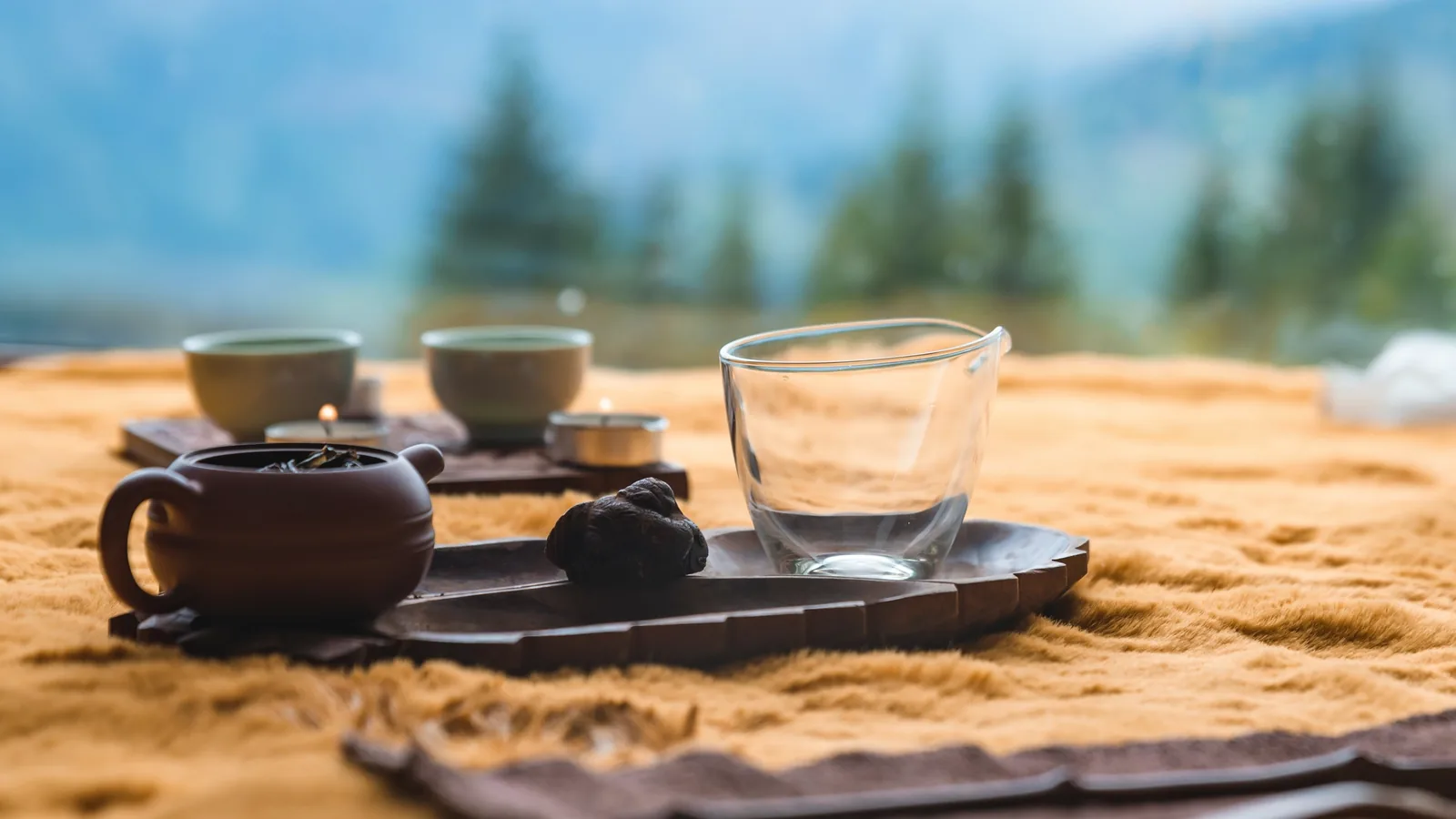
You do not need a table with twenty items on it. Four things are enough for a complete start: a gaiwan or teapot of 100–130 ml, a chahai, one or two comfortable cups, and a cloth — plus a kettle or a thermos for hot water.
Diagram 8Minimal set: four items and water
Gaiwan or teapot
100–130 ml
Chahai
One or two cups
Cloth
+ water
kettle or thermos
Cold-water test: pour into the chahai, check the stream, the grip, and the lid.
Author’s photograph
MEDIA ID
P01
STATUS
PLACED
PLACEMENT
Ch. 5 · Minimal set
NEEDS
author’s photography by Yevhen Vovk; brief in the illustration package
Gaiwan or teapot? A white porcelain gaiwan is an excellent all-round instrument: affordable, easy to wash, does not absorb odors, and lets you see the leaves unfurl. If you find a handle more comfortable to work with, choose a small teapot.
Cold-water test. Before using a new vessel with boiling water, fill it with cold water and pour it into the chahai. Check the stream, your grip, and the position of the lid.
6. Water, Temperature, and Infusions
The tea in your cup is almost entirely water. Water that is too hard can mute delicate aroma and leave a film; water with no minerals at all often produces a flat liquor. Start with clean, soft drinking water with a mineral content of roughly 50–150 mg/L. Taste it warm on its own, apart from the tea, and compare it with another water you have on hand.
STARTING CHART FOR BREWING IN SHORT INFUSIONS
Leaf quantities are for a 100 ml vessel. Starting from the second or third infusion, try adding 5–10 seconds as the leaves unfurl.
Green and yellow — 3–4 g; 75–85 °C; 10–20 s. Leave the lid open between infusions.
White — 4–5 g; 85–90 °C (up to 95 °C for aged white tea); 15–25 s.
Light oolong — 5–6 g; 90–95 °C; 15–25 s.
Dark oolong (Wuyishan, dancong) — 5–7 g; 95–98 °C; 5–10 s. Keep the first infusions brief.
Red — 4–5 g; 85–92 °C; 10–15 s.
Young sheng pu'er — 4–5 g; 85–92 °C; 5–10 s.
Aged sheng and shu pu'er — 5–7 g; 95–100 °C; 10–15 s. Compressed tea can be given a quick rinse first.
Diagram 3Starting brewing chart · 100 ml vessel
Tea
Leaf
Water
1st infusion
Note
Green and yellow
3–4 g
75–85 °C
10–20 s
leave lid open between infusions
White
4–5 g
85–90 °C aged — up to 95 °C
15–25 s
Light oolong
5–6 g
90–95 °C
15–25 s
Dark oolong Wuyishan, dancong
5–7 g
95–98 °C
5–10 s
first infusions brief
Red
4–5 g
85–92 °C
10–15 s
Young sheng pu'er
4–5 g
85–92 °C
5–10 s
Aged sheng and shu pu'er
5–7 g
95–100 °C
10–15 s
compressed tea can be given a quick rinse
From the second or third infusion, add 5–10 s as the leaves unfurl.
Diagram 4Gaiwan → Chahai → Cup
Gaiwan
pour water in, steep for the set time
Chahai
decant to the last drop: extraction stops, strength evens out
Cup
pour into cups and drink in small sips
WHAT TO ADJUST IF THE TASTE DISAPPOINTS
Bitter and astringent — reduce the steeping time, water temperature, or leaf amount. Try making the next infusion shorter.
Pale and watery — use hotter water or lengthen the time. Tightly rolled leaves unfurl gradually.
The tea gives out by the third infusion — use more dry leaf, or make the first infusions shorter.
Diagram 9What to adjust if the taste disappoints
Bitter and astringentless time, lower temperature, or less leaf; make the next infusion shorter
Pale and wateryhotter water or longer time
Gives out by the third infusionmore dry leaf or shorter first infusions
7. Pincha and Gongfu Cha: The Basic Protocol
Pincha (品茶) is attention to the taste and character of tea. Gongfu cha (工夫茶) is the skill of working deftly with small teaware and short infusions.
Set aside 20–30 minutes. You will need a gaiwan or teapot, a chahai, cups, a chahe, tea, and hot water.
1. Prepare your space. Clear the table in front of you. Set the hot water to the side, and place the brewing vessel, chahai, cup, and cloth in front of you.
2. Meet the tea in the chahe. Measure out about 5 g of tea. Look closely at the dry leaves, bring the vessel to your face, and breathe calmly through the tea.
3. Warm the teaware. Pour hot water into the empty gaiwan or teapot, decant it into the chahai, from there into the cups, and then pour it away.
4. The breath of warm tea. Transfer the leaves into the warmed vessel, cover it for a few seconds, give it a gentle shake, tip the lid open slightly, and breathe in the aroma.
5. First infusion. Pour water of the right temperature over the leaves. Steep for the time shown in the chart, then decant completely into the chahai.
6. Pouring into cups. Pour the liquor from the chahai into the cups. If you are drinking with friends, the chahai gives everyone liquor of the same strength.
7. The sip. Let the tea cool slightly. Take a sip, letting the liquor spread through your whole mouth.
8. Aftertaste and the empty cup. Feel what remains after the sip, then bring the empty cup to your nose and breathe in the aroma of the warm porcelain.
9. A series of infusions. Steep again, watching how the character of the tea changes. Good tea unfolds over several infusions; some teas hold up for five to ten infusions or more.
10. A clean finish. Remove the spent leaves, wash the teaware in a way suited to its material, and leave it to dry completely.
Diagram 10Gongfu cha: the basic protocol in drawings
01Prepare the space
03Warming the teaware
04Leaf into the warmed vessel
05First infusion
05Decant into the chahai to the last drop
06Pouring into the cups
09A series of infusions
10A clean finish
The numbers match the steps of the protocol above.
Video · 1–2 minWorking with a Gaiwan
Author's video demonstration — coming soon
MEDIA ID
V02
STATUS
AWAITING AUTHOR
PLACEMENT
Ch. 7 · Pincha and Gongfu Cha
NEEDS
filming with Yevhen; script, shot list, and poster in preparation in package V
Video · 5–10 minFull Gongfu Cha Protocol
Author's video demonstration — coming soon
MEDIA ID
V03
STATUS
AWAITING AUTHOR
PLACEMENT
Ch. 7 · Pincha and Gongfu Cha
NEEDS
filming with Yevhen; script, shot list, and poster in preparation in package V
PART II. PRACTICE
8. Aisthesis: Why Develop Sensitivity
The name AESTHESYS goes back to the Ancient Greek aisthesis — the capacity to sense and to discern through the senses.
In ordinary life, the hand picks up a cup on autopilot: we notice the result (“I had some tea”), while the living fabric of the action is lost to habit. Yet within those two seconds lies a whole world: the impulse in the shoulder, the first contact of the fingers with the warm glaze, the transfer of weight from the table into the torso and pelvis, the wave of aroma, and the shifting taste in the mouth.
In the philosophy of AESTHESYS, the body is the visible and tangible layer of our existence, the immediate place of our participation in the world. By developing sensitivity, we learn to notice more distinctions in what is happening. This allows us to act with greater precision, change our habitual course, reduce unnecessary effort, and leave room for what arises in our encounter with the world.
A tea ceremony offers an intimate setting for this exploration: here, in a single simple action, seven directions of perception meet — time, weight and volume, touch, taste, aroma, light, and sound.
9. AESTHESYS TEA Practice Protocol
A score of embodied attention · 45 minutes
Audio · 45 minGuided TEA Practice
Temporary version with an AI voice; it will be replaced by the author’s own recording.
MEDIA ID
A01-EN
STATUS
DRAFT
SOURCE
EN Normal script (consilium, 11.11.2026) · AI voice “Yu Gen” · A01 music · 45 min
NEEDS
author’s recording by Yevhen; AESTHESYS is pronounced “es-TEH-zis”
THE SEVEN FOCUSES OF THE PRACTICE
1. Be in your own time (Move slowly).
2. Sense your weight and limits (Weight — volume).
3. Touch from the depths (Let your touch grow lighter).
4. Know the taste of water (Taste).
5. Breathe with your whole self (Aroma).
6. Look wider (Look at the light).
7. Listen to your heart (Hearing).
The full practice takes about 45 minutes. Two processes unfold in parallel: you brew and drink tea infusion after infusion, while your attention moves sequentially through the seven focuses and brings them together at the end.
PREPARING THE SPACE
Sit on a chair or cushion with comfortable support under your pelvis. In front of you are your brewing vessel, a chahai, a tea cup, a separate small cup of warm plain water (you will need it in the fourth focus), and a chahe with dry tea. Put your phone on silent. If at any point you want to shift position, adjust your cushion, or stretch — do it inside the practice.
Video · 1 minPreparing the Tea Space
Author's video demonstration — coming soon
MEDIA ID
V01
STATUS
AWAITING AUTHOR
PLACEMENT
Ch. 9 · Preparing the Space
NEEDS
filming with Yevhen; script, shot list, and poster in preparation in package V
I. SENSE OF TIME: “BE IN YOUR OWN TIME”
Leave your hands free and slowly move your palm through the air in front of you. Imagine a drop of thick ink smoothly spreading through a glass of clear water. Choose a comfortable pace, noticeably slower than everyday speed. Feel how the movement begins, how it flows and changes direction.
Now slow down even more. At some point you will notice your hand beginning to “skip” across parts of the trajectory — the movement breaks into discrete steps. Play with this sensation: slow down just a little more and find a drawn-out continuity inside it, as if you have just woken up in the morning, stretching with pleasure and coming into your own body. At this pace, you may feel as though the world around you is beginning to adjust to your speed.
Keeping this slow rhythm, pick up the chahe, bring it to your face, and breathe calmly through the dry tea. Then, in the same unhurried rhythm, brew the first infusion and pour the tea into the chahai and your cup. When setting teaware down on the table, wait for the moment the surface takes the weight, and only then let your fingers release it. From this moment on, do everything slowly, including shifting position and adjusting your clothes.
Diagram 11Sense of time: continuous and discrete movement
Slow and continuous — a pace noticeably slower than everyday speed
Even slower — the hand “skips” across sections, the movement becomes discrete
Just a little slower — a drawn-out continuity returns inside
Video · 1–2 minTime and Slow Movement
Author's video demonstration — coming soon
MEDIA ID
V04
STATUS
AWAITING AUTHOR
PLACEMENT
Ch. 9 · Focus 01
NEEDS
filming with Yevhen; script, shot list, and poster in preparation in package V
II. WEIGHT — VOLUME: “SENSE YOUR WEIGHT AND LIMITS”
Leave your cup on the table and free your hands. Feel the support beneath you. Ask yourself not how many kilograms you weigh, but how you weigh right now. Imagine your weight melting like candle wax and flowing down through your body into the floor: the weight of your head — into your chest and shoulders; the weight of your chest — into your belly; the weight of your shoulders — into your arms; the weight of your belly and legs — into your pelvis; the whole weight of your body — further down, into the floor.
Slowly raise one arm a little. When you take a familiar bag of sugar from a shelf, its weight is already in your muscle memory; if it were filled with lead, you would feel the difference at once. Feel the living weight of your arm right now against the background of your whole body, then smoothly lower it. Check your other arm, the weight of your head, and the overall weight of your body.
Close your eyes. Imagine a fine thread between your two ears and feel its length from inside. Then, one by one, feel the same threads: between your shoulders, your elbows, your wrists, your hip bones, your knees, your heels — and a long thread from the crown of your head to your tailbone.
Form an inner triangle between your two pupils and your navel, and next — a level square between your collarbones and your shoulder blades.
Turn to volume: feel your head from inside like a balloon; then — your chest and belly together; both arms together; both legs together. Take five breaths, imagining on each out-breath that you are breathing out through the whole surface of your skin, like a sea sponge.
Bring the volume together with the flowing weight in a single center of weight and volume: “How I weigh. How much space I take up. This is me, physically.” Slowly open your eyes.
Diagram 12Weight — volume: weight flows into the floor
Triangle: two pupils and navel · Square: collarbones and shoulder blades
Diagram requires author review
Video · 2–3 minWeight — volume
Author's video demonstration — coming soon
MEDIA ID
V05
STATUS
AWAITING AUTHOR
PLACEMENT
Ch. 9 · Focus 02
NEEDS
filming with Yevhen; script, shot list, and poster in preparation in package V
III. TOUCH: “TOUCH FROM THE DEPTHS”
Close your eyes and very lightly touch your closed eyelids with your fingertips — without pressure. Feel the moment of contact, and then, leaving your fingers in place, gradually step back inward with your attention: from your fingertips into your hand, into your elbow, into your shoulder, and further — into the center of your weight and volume. Listen to the touch at the periphery from this deep center.
Play with shifting your attention to your fingertips and back. Imagine a spoon you use to lift a piece of potato out of soup: the spoon touches the potato, but you are holding the handle. Try to feel the connection between the place of touch and the place from which it happens.
Open your eyes, touch the fabric of your clothes, then touch the table with your whole palm, each time stepping back with your attention into your center.
Reach out toward the cup of warm tea: first only touch it lightly (“stick” to the porcelain), step back with your attention into the center of your weight and volume, and then comfortably take hold of it and lift it. Take the cup with your center — feel its weight pass through your hands and body into your center of weight and volume and flow down into the floor.
Slowly return the cup to the table, waiting until the surface takes its weight. Notice the touch of the support beneath you, your clothes, and the air against the skin of your whole body.
Diagram 13Touch: stepping back with attention into the center
01Fingertips
02Hand
03Elbow
04Shoulder
05Center of weight and volumelisten to the touch from here
What to touch
closed eyelidsfabric of your clothestable — with your whole palmcup: touch → into center → take with center
Video · 2–3 minTouch from the Depths
Author's video demonstration — coming soon
MEDIA ID
V06
STATUS
AWAITING AUTHOR
PLACEMENT
Ch. 9 · Focus 03
NEEDS
filming with Yevhen; script, shot list, and poster in preparation in package V
IV. TASTE: “KNOW THE TASTE OF WATER”
First take the small cup of warm plain water: touch it, step back into your center, receive its weight. Take a sip of water and feel its temperature, softness, density, and the trace it leaves after the sip. Set the cup down.
Now take the cup of warm tea from the center of your weight and volume. Take a sip with a loud, distinct slurp — briefly draw the tea in together with air. “The more terrible, the better!” Let your lips and cheeks join in freely, and spread the tea throughout your whole mouth — across your tongue, palate, and cheeks.
Leave words and descriptions for later; stay inside the whole volume of the taste. Swallow the tea, lower the cup, and listen to the aftertaste in your throat. Finish the cup in your own rhythm, and when it is empty, bring it to your nose and breathe calmly through it.
Diagram 14Taste: from water to the empty cup
01Sip of warm watertemperature, softness, density, trace
02Sip of tea with a slurpthroughout the whole mouth
03Whole volume of tastewords — for later
04Aftertaste in the throat
05Empty cup at the nose
V. AROMA: “BREATHE WITH YOUR WHOLE SELF”
Keep holding the empty warm cup near your face and breathe evenly through it — both the in-breath and the out-breath. The cup stays the same — the angle of your attention changes.
One by one, imagine breathing the aroma in and out with:
— the tip of your nose;
— the wings of your nose;
— the base of your nose;
— your throat;
— your chest;
— your whole body, the entire surface of your skin, like a sponge.
Recall the whole path and return your attention to the place where the aroma opened most fully. Stay there for a while, and slowly set the cup down on the table, waiting until the surface takes its weight.
Diagram 15Aroma: the path of the in-breath and out-breath
01Tip of the nose
02Wings of the nose
03Base of the nose
04Throat
05Chest
06Whole bodythrough the entire surface of the skin, like a sponge
Video · 2–3 minTaste and Aroma
Author's video demonstration — coming soon
MEDIA ID
V07
STATUS
AWAITING AUTHOR
PLACEMENT
Ch. 9 · Focuses 04–05
NEEDS
filming with Yevhen; script, shot list, and poster in preparation in package V
VI. SIGHT — “LOOK WIDER”
Free your hands. Hold up two fingers in front of you, slowly draw them wide apart to the sides, and release the sharpness of your eyes — enter soft defocusing. Lower your hands.
Look at the space of the room as a whole: light, color, the air between things. As if you were inside a transparent colored jelly. If the room had a single Instagram filter over it, what tint would it have? Bring this wide gaze together with the sensation of your weight and volume, and of your support.
Without bringing sharpness back to your eyes, slowly guide your hand toward the empty cup at room temperature standing in front of you. Let your hand meet it: if your fingers touch a little off to the side, gently adjust your palm. Touch it, step back with attention into the center of your weight and volume, take the cup with your center, lift it, feel the trust in your body, and smoothly set it back on the table.
Whenever you brew with boiling water, return to clear sight.
Diagram 16Sight: looking wider
01Two fingers — draw apart to the sidessoft defocusing
02The whole roomlight, color, air between things
03Wide gaze + weight — volume
04Hand to the empty cupwithout restoring sharpness
Video · 1–2 minDefocusing sight
Author's video demonstration — coming soon
MEDIA ID
V08
STATUS
AWAITING AUTHOR
PLACEMENT
Ch. 9 · Focus 06
NEEDS
filming with Yevhen; script, shot list, and poster in preparation in package V
VII. HEARING — “LISTEN TO YOUR HEART”
Listen to all the sounds around you: near and far, loud and quiet. Let all of them become part of a single orchestration — the noise beyond the window, the murmur of water, the rustle of your clothes.
Gradually shift your attention toward the quietest sounds: your own movement, your in-breath and out-breath, and then deeper still — to the subtle sound of blood in your ears and the beating of your own heart.
Listen to your heart. Leave the list and stay in silence for a while, feeling your weight and volume within the sounding space.
Diagram 17Hearing: from the orchestra of space to the heart
Attention moves from the outer circles toward the center.
VIII. THE LAST CUP — INTEGRATION
With clear sight, brew and pour your last cup without hurrying. Touch it, step back into the center of your weight and volume, and take the cup with your center.
Now play freely with everything you have come to know: keep the slow rhythm and your weight and volume, feel the touch of the cup, take a sip, breathe the aroma from the bottom of the empty cup, soften your gaze into the wide light of the room, and listen to the space.
Bring together two focuses, then three, and perhaps all seven — into a single integrated presence.
Stay in silence for a while. Let it come to its natural end. Set the cup on the table, fold your hands in front of your chest, and slowly turn the empty cup upside down. The practice is complete.
Diagram 18The last cup: two focuses, three — and all seven
Video · 2–3 minIntegration of the seven focuses
Author's video demonstration — coming soon
MEDIA ID
V09
STATUS
AWAITING AUTHOR
PLACEMENT
Ch. 9 · VIII
NEEDS
filming with Yevhen; script, shot list, and poster in preparation in package V
10. EIGHT TECHNICAL ETUDES
Eight exercises for precision of movement, sensitivity, and the skill of letting go in time. They are easy to do on their own, apart from the full practice, with cool water.
1. A full cup on a napkin.
Place two dry paper napkins on the table. Pour cool water into a cup almost to the brim (to the point where surface tension holds it) and smoothly carry it from the first napkin to the second without spilling a drop. The water will reveal the slightest hidden jerk at the start or the finish. In the full version, swap the places of three cups on three napkins.
2. Lid and tongs.
Using a dry, cold teapot, lift the lid with bamboo tongs and set it down in complete silence — without the clink of porcelain on porcelain. You will notice that a silent finish is decided even before the start: in the angle of the grip and the support of the pelvis.
3. The moment of release.
Slowly set the cup on the table and follow the boundary between the first contact with the wood and the full transfer of weight. Open your fingers when the table has taken all the weight.
4. Minimal effort.
Lift the cup and notice how firmly your fingers are gripping it. Smoothly release the excess tension in your hand down to the threshold where the grip stays secure while the hand becomes soft.
5. Tuning (separating gaze and attention).
Sitting at the table before the first infusion, look down while directing your attention upward. Then: gaze to the right — attention to the left; gaze upward — attention downward; gaze to the left — attention to the right. After that, release your gaze into the wide periphery, gather your attention at the center, and reach for the cup. Feel how the gesture has changed.
6. Blind action.
Look at where the empty cup is standing. Close your eyes, and in a slow rhythm find it with your hand from the center of your weight and volume, lift it, and return it to its place.
7. One infusion — two temperatures.
Pour a cup of tea: taste part of the liquor hot (comfortably hot), and the rest three minutes later, once the tea has cooled. Notice how temperature changes the balance of sweetness, body, and astringency.
8. Twenty-One Sheets.
For three weeks in a row, brew tea on a clean white sheet of paper, and at the end of each tea session write the date on it. The traces of drops will leave a documentary cardiogram of your hand. At what moment do you begin to rush? Only the sheet of someone who brewed nothing can stay completely dry.
Video · 4–6 minEight Technical Etudes
Author's video demonstration — coming soon
MEDIA ID
V10
STATUS
AWAITING AUTHOR
PLACEMENT
Ch. 10
NEEDS
filming with Yevhen; script, shot list, and poster in preparation in package V
11. MICRO-PRINCIPLES BEYOND THE TEA TABLE
The skills of TEA Practice carry over into everyday life through brief points of shifting attention.
SENSE OF TIME
— Notice the beginning of a movement before its result. Try this when your hand reaches for your phone or a door handle.
— Leave a gap in which the trajectory can still be changed. While walking down the street or moving around the kitchen.
WEIGHT — VOLUME
— Let the support carry you instead of holding unnecessary tension in your shoulders. Sitting in a chair in front of a screen or in transit.
— Breathe out through the whole surface of your skin, like a sponge. In a moment of fatigue or overload.
TOUCH
— Touch first, and only then receive the weight with your center. When lifting a cup, a bag, or an object from a table.
— Listen to touch from deep within the center of your body. When embracing or touching someone close to you.
TASTE
— Feel the taste itself before attaching a judgment to it. On the first sip of morning water or during lunch.
AROMA
— Breathe in the scent of the space without greedily sniffing. Stepping out of the house into the morning or evening air.
SIGHT
— Release the tunnel-vision aim and notice the light and air between things. During a pause in work or a walk in the park.
HEARING
— Hear the timbre of the other person's voice and leave a second of silence before your answer. In the middle of an important or difficult conversation.
PART III. 21 DAYS
12. THE 21-DAY TEA CHALLENGE
The program is designed for 5–15 minutes a day during your ordinary tea session.
Week 1 — DISCOVER: one focus of perception per day.
Week 2 — REFINE: precision of gesture and nuances of tea.
Week 3 — INTEGRATE: carrying attention into everyday life.
After each day, write down one short observation sentence. If you miss a day, continue from the same task.
Notes and checkmarks are saved only in this browser.
WEEK 1. DISCOVER — TO FEEL
Day 1. Your Own Time.
Move an empty hand through the air like a drop of ink in water. Find the transition from discrete steps to smooth continuity, and pour a cup of tea at this pace.
Question of the day: at what second did I want to speed up?
You will need tea, brewing vessel, cup
Day 2. Weight — Volume.
Let your weight melt like a candle into the support, gather the inner threads, the triangle (pupils — navel) and the square in your chest, and breathe through your skin like a sponge.
Question of the day: where was I holding extra weight suspended?
You will need chair or cushion with support under the pelvis
Day 3. From the Depths.
Touch your closed eyelids, step back with attention into the center of your weight and volume, and then take the cup of tea from that center.
Question of the day: how does the cup change when you take it not with your fingers alone, but with your whole body?
You will need cup of warm tea
Day 4. The Taste of Water and Tea.
Take a sip of warm water, and right after — a sip of tea with a loud slurp, bathing your whole mouth. Listen to your throat half a minute later.
Question of the day: what began in my mouth after the tea had already been swallowed?
You will need cup of warm pure water, cup of tea
Day 5. Geography of Aroma.
Breathe through an empty warm cup, shifting the focus: tip of the nose → wings → base → throat → chest → whole body.
Question of the day: at which point did the aroma open most deeply?
You will need empty warm cup
Day 6. The Light of the Room.
Draw your fingers apart toward the edges of your periphery, enter a soft defocusing, and pick up the cup from the table while keeping a soft gaze.
Question of the day: how does trust in the hand feel in the body?
You will need cup on the table
Day 7. The Orchestra and the Heart.
Listen to all the sounds in the room as a single orchestra, gradually moving toward your breathing and pulse. If you have 45 minutes, go through the entire TEA Practice.
Question of the day: what quiet sound did I catch today?
You will need quiet room; for the full practice — the complete set
WEEK 2. REFINE — TO HONE
Day 8. Water as a Mirror.
Carry a full cup of cool water from one dry napkin to another without spilling a drop.
Question of the day: where did the movement waver — at the start or when stopping?
You will need cup, cool water, two dry napkins
Day 9. The Silent Lid.
Five times, lift and replace the lid of the teapot with tongs so that the porcelain makes no sound at all.
Question of the day: how does support in the pelvis affect the precision of the tips of the tongs?
You will need teapot with a lid, bamboo tongs
Day 10. Clean Release.
On every infusion, watch for the moment when the table has fully taken the weight of the cup and the chahai before you unclasping your fingers.
Question of the day: how often did I mentally drop an object before I had set it down?
You will need brewing vessel, chahai, cup
Day 11. Two Temperatures.
Compare the very same tea liquor hot and after it has cooled for five minutes.
Question of the day: what notes woke up only after cooling?
You will need cup of tea, five minutes
Day 12. A Contrasting Pair.
Brew two different teas side by side — for instance, a light and a dark oolong — and write down three simple words about the taste of each before reading the labels.
Question of the day: what did I sense on my own, without a prompt?
You will need two different teas, two vessels, paper and pen
Day 13. Two Waters.
Brew one familiar tea with two different waters.
Question of the day: how did the water change the body and the aftertaste?
You will need one tea, two different waters
Day 14. Gathering the Whole.
Brew tea and try to hold two, and then three focuses of attention at once — weight and volume, the taste in your mouth, and the wide light of the room.
Question of the day: which sensations come together easily, and which one drops out first?
You will need brewing vessel, tea
WEEK 3. INTEGRATE — TO CARRY INTO LIFE
Day 15. The Gap Before Action.
While making breakfast or getting ready in the morning, notice the moment you start rushing by inertia, and smoothly slow your pace.
Question of the day: where was speed my choice today, and where was it habit?
You will need morning, kitchen
Day 16. Support in the Middle of the Day.
Three times during your workday in front of a screen, check your shoulders and jaw and release your weight to flow down into the seat and your feet.
Question of the day: how much unnecessary effort do I spend simply sitting on a chair?
You will need workspace
Day 17. Meeting in Handing Over.
When handing an object to another person — a cup, keys, a document — wait for the moment their hand has received the weight, and only then let go.
Question of the day: what does a moment of shared action feel like?
You will need an object to hand over, another person
Day 18. The First Second of Taste.
At lunch or dinner, take the first three sips or bites without your phone or conversation, listening to the texture and temperature of the food.
Question of the day: what changes when you don't swallow an impression on the run?
You will need lunch or dinner without a phone
Day 19. The Trace of Aroma.
Outside or at home, catch one living scent and notice what memory or shift of state it called up in your body.
Question of the day: what "weather of memory" did this scent bring?
You will need street or home
Day 20. Tuning Your Sight.
Before starting work, do the two-minute "Tuning" exercise: gaze down — attention up, then along the cross, and after that open a wide gaze.
Question of the day: how does the sense of space around the monitor change?
You will need workspace, two minutes
Day 21. A Pause in Dialogue.
In a conversation with someone close to you or a colleague, listen to the voice itself, and when the other person finishes speaking, leave one calm second of silence before your answer.
Question of the day: what kind of answer is born out of a pause?
You will need conversation with someone close or a colleague
13. CHEAT SHEETS, STORAGE, AND CARE
GONGFU CHA IN ONE LINE
Dry tea in the chahe → warm the teaware → warm the leaves in the brewing vessel → pour water in → decant on time to the last drop into the chahai → pour into cups → sip → aftertaste → aroma of the empty cup → next infusion.
TEA PRACTICE IN ONE LINE
Slow down → let your weight flow into the floor and gather weight and volume → touch from your center and take the cup with your center → know the taste of water and slurp the tea → breathe the aroma of the empty cup with your whole body → release your gaze into the light → listen to the orchestra of the space and your heart → unite the focuses in silence → turn the empty cup upside down.
TEA STORAGE AND TEAWARE CARE
The four enemies of tea: foreign odors (spices, coffee, perfume), moisture, direct sunlight, and heat. Store tea in a tightly sealed opaque package in a dry cupboard away from the stove. For long-term storage, green teas and light Taiwanese oolongs like cool temperatures. Place tea in the refrigerator only in tightly sealed factory packaging so it does not absorb odors and moisture.
After a tea session, remove the leaves, wash the teaware in a way suited to its material, and leave it to dry with the lid off. Do not leave wet tea leaves in a closed teapot for several days.
WHAT TO KEEP IN THE END
A little good tea that is a pleasure to brew on an ordinary Tuesday. A cup that fits comfortably in your hand. The ability to give yourself time. And the right, on any evening, to set protocols aside and simply drink tea with those who are dear to you.
Philosophy and research: Yevhen Vovk. "AESTHESYS Philosophical Foundation" (Revision 7); "TEA Practice Protocol" and "Facilitation Score"; "Precision · Release · Agency" (Research Note).
Classics and history: Lu Yu, "Cha Jing" ("The Classic of Tea", 8th century); museum and technological materials of the National Palace Museum and the Taiwan Tea and Beverage Research Station (Taiwan); Lu H. et al., "Earliest tea as evidence for one branch of the Silk Road", Scientific Reports (2016); Jiang J. et al., Scientific Reports (2021).